🩺Medically reviewed by Dr Mary Ann Y. Huang, MD
- 🧬 Ozempic Liver Effects: The Discovery That Surprised Researchers
- 🔍 The Hidden GLP-1 Receptors Inside the Liver
- 📖 The ESSENCE Trial: Ozempic’s “Miracle” Liver Story
- ⚠️ The Ozempic Liver Damage Story Few People Hear About
- 🧈 Ozempic Liver Effects and the Gallbladder Connection
- 🔥 Rapid Weight Loss Can Temporarily Stress the Liver
- ⏳ Your Body Was Never Designed for Continuous GLP-1 Stimulation
- 📉 What Happens After People Stop Ozempic?
- 🩺 The Real Root Problem: Insulin Resistance
- 🍖 How to Protect Yourself While Taking Ozempic
- 🧭 Final Thoughts on Ozempic Liver Effects
- ❓FAQs About Ozempic Liver Effects
Most people think Ozempic only affects appetite and weight loss. However, according to emerging research and shocking real-world case reports, Ozempic may directly affect your liver in ways scientists themselves barely understood until recently.
In fact, one major study showed Ozempic dramatically improved liver inflammation and even reversed fibrosis in patients with advanced fatty liver disease. Yet another report described a 67-year-old woman whose liver enzymes skyrocketed into acute liver failure territory only two weeks after starting the drug.
So which story is true?
Oddly enough, both are.
And that’s exactly what makes this conversation so important.
🧪 New research published in 2026 suggests Ozempic works directly on the liver through hidden GLP-1 receptors scientists previously overlooked. Meanwhile, doctors are also discovering that rapid fat loss, gallbladder dysfunction, preexisting fatty liver disease, and poor metabolic health may create dangerous complications in certain patients.
The problem is not that Ozempic is simply “good” or “bad.”
The real problem is that millions of people are taking it without fully understanding what it may actually be doing inside the liver.
🧬 Ozempic Liver Effects: The Discovery That Surprised Researchers
For years, researchers believed Ozempic improved liver disease mainly because patients lost weight.
The logic seemed simple:
- lose weight
- reduce liver fat
- lower inflammation
- improve liver health
However, scientists at the University of Toronto published findings in April 2026 that challenged that entire assumption.
The research team engineered mice that physically could not lose weight while taking Ozempic.
Then they gave the drug to those mice anyway.
And something remarkable happened.
Even without losing a single ounce of weight, research suggests that the mices:
- liver inflammation improved
- fibrosis decreased
- metabolic markers improved
That discovery changed the conversation overnight.
Because suddenly researchers realized Ozempic may directly interact with the liver itself.
Not just body weight.
🔍 The Hidden GLP-1 Receptors Inside the Liver
🩺 The breakthrough centered around GLP-1 receptors.
Ozempic mimics a hormone called GLP-1, which naturally helps regulate:
- insulin
- blood sugar
- appetite
- digestion
For decades, scientists mainly focused on how GLP-1 worked in:
- the pancreas
- the brain
- the digestive system
However, researchers discovered something unexpected.
GLP-1 receptors were also hiding inside liver tissue.
That means Ozempic may directly influence:
- liver inflammation
- fat metabolism
- fibrosis
- scarring
without depending entirely on weight loss.
And according to the transcript you provided, even Daniel Drucker — the scientist who co-discovered GLP-1 in the 1980s — became fascinated by how dramatic some liver improvements looked compared to the actual amount of weight patients lost.
Experts believe something deeper was clearly happening.
📖 The ESSENCE Trial: Ozempic’s “Miracle” Liver Story
One of the biggest studies mentioned in the transcript was the ESSENCE Trial, published in the New England Journal of Medicine.
Researchers followed approximately 800 patients suffering from:
- fatty liver disease
- inflammation
- fibrosis
- metabolic dysfunction
Importantly, every patient received a liver biopsy before treatment began.
Then researchers compared Ozempic against placebo over 72 weeks.
The results looked incredibly impressive.
📊 According to the trial:
- 63% of patients taking Ozempic experienced complete resolution of liver inflammation
- only 34% improved on placebo
- 37% showed measurable fibrosis improvement
- placebo achieved only 22%
That fibrosis improvement matters enormously because fibrosis represents scar tissue inside the liver.
And scar tissue becomes dangerous because once enough fibrosis develops, liver function can permanently decline.
Eventually, in August 2025, the FDA officially approved Wegovy — essentially the same drug — for certain advanced liver disease conditions involving inflammation and scarring.
However, the transcript repeatedly emphasizes one extremely important detail:
These patients received close medical supervision.
Doctors carefully monitored:
- liver health
- dosage progression
- metabolic markers
- disease severity
That does not reflect how many people currently use Ozempic for rapid weight loss alone.
⚠️ The Ozempic Liver Damage Story Few People Hear About
Now comes the other side of the story.
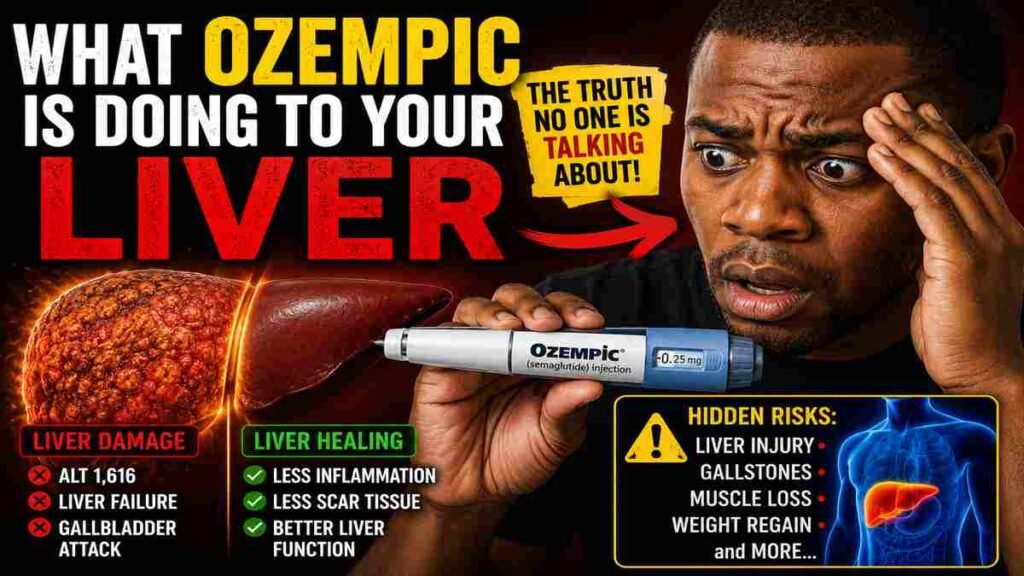
🧪 The transcript described a shocking case involving a 67-year-old woman.
She reportedly started Ozempic for weight loss after bariatric surgery.
Only two weeks later, she landed in the emergency room.
Her ALT liver enzyme measured 1,616.
To understand how serious that number is:
- normal ALT remains under 40
- severe alcoholic liver disease may reach 200
- acute liver failure often ranges between 1,000–3,000
Her liver entered dangerous territory extremely fast.
And suddenly the Ozempic narrative becomes much more complicated.
How can one study show liver healing while another patient experiences severe liver injury?
According to the transcript, the answer may involve:
- preexisting fatty liver disease
- rapid fat mobilization
- gallbladder dysfunction
- poor metabolic health
- lack of monitoring
- aggressive dosing
In other words:
Ozempic may help certain livers while overwhelming others.
🧈 Ozempic Liver Effects and the Gallbladder Connection
🟢 One of the most overlooked sections of the transcript involved the gallbladder.
Your gallbladder sits directly underneath the liver and stores bile.
That bile helps process:
- fats
- cholesterol
- toxins
- metabolic waste
According to the transcript, constant GLP-1 stimulation from Ozempic may slow gallbladder contractions.
When that happens:
- bile becomes stagnant
- sludge forms
- gallstones may develop
- bile can back up toward the liver
Eventually, that backup may increase stress on the liver itself.
This became serious enough that the FDA required Novo Nordisk to add warnings about acute gallbladder disease to Ozempic labeling in 2023.
And yet most people discussing Ozempic online barely mention the gallbladder at all.
🔥 Rapid Weight Loss Can Temporarily Stress the Liver
Many people assume rapid weight loss automatically improves fatty liver disease.
Ironically, the transcript explains the process may initially do the opposite.
Here’s why.
When you lose weight rapidly:
- huge amounts of fat release into circulation
- the liver must process that fat
- bile demand rises sharply
- oxidative stress may increase
A healthy liver often adapts.
However, the transcript highlighted a critical statistic:
📊 Roughly 38% of adults already have some degree of fatty liver disease.
Many do not even know it.
That means millions of Ozempic users may begin treatment with compromised liver function already present underneath the surface.
And when rapid fat breakdown suddenly floods the liver, complications may emerge.
⏳ Your Body Was Never Designed for Continuous GLP-1 Stimulation
🧬 Another fascinating point from the transcript involved duration.
Naturally produced GLP-1 only lasts about:
- 90 seconds
Ozempic lasts:
- roughly 7 days
That means the body experiences nonstop stimulation far beyond normal biological design.
According to the transcript:
“The gut, gallbladder, and liver were never designed to have that much stimulation.”
That statement may explain why some patients experience:
- nausea
- gallbladder issues
- digestive slowing
- metabolic complications
particularly during rapid dosage escalation.
📉 What Happens After People Stop Ozempic?
The transcript also discussed a major concern many advertisements ignore.
Research showed that after discontinuing Ozempic:
- patients regained roughly two-thirds of lost weight
- blood sugar improvements reversed
- cardiovascular markers worsened again
Even more concerning, body composition studies found:
- 25% of weight loss came from lean tissue
- muscle mass declined
- bone density may decrease
That matters because muscle tissue helps regulate:
- metabolism
- insulin sensitivity
- long-term health
- aging
Losing too much muscle may create entirely new metabolic problems later.
🩺 The Real Root Problem: Insulin Resistance
According to the transcript, Ozempic does not truly fix the root cause of obesity.
Instead, it bypasses symptoms temporarily.
The deeper issue remains:
Insulin Resistance
Insulin resistance develops when cells stop responding properly to insulin.
As a result:
- weight loss becomes difficult
- fat storage increases
- hunger worsens
- metabolism slows
Ozempic may improve symptoms while the drug remains active.
However, unless patients improve:
- diet
- metabolic health
- insulin sensitivity
- muscle preservation
many eventually regain weight once treatment stops.
That’s why the transcript repeatedly emphasized:
“The root problem is still there.”
🍖 How to Protect Yourself While Taking Ozempic
The transcript also provided several practical recommendations.
Prioritize Protein
🥩 Rapid weight loss increases muscle loss risk.
The transcript specifically recommended:
- adequate animal protein
- muscle preservation strategies
- resistance training
to reduce lean tissue loss.
Lower Carbohydrate Intake
🥑 Lowering carbohydrates may help improve insulin resistance naturally.
Without reducing insulin levels, long-term metabolic improvements become much harder to maintain.
Add Fermented Foods
🥬 The transcript also mentioned:
- kimchi
- sauerkraut
- fermented fiber
because they may naturally support GLP-1 signaling and gut health.
Exercise Matters More Than Ever
🏋️ Resistance training becomes especially important during GLP-1 treatment because preserving muscle protects metabolism.
Without exercise, rapid weight loss may accelerate lean tissue decline.
⚖️ Ozempic Is Neither Miracle Nor Poison
The biggest takeaway from the transcript is balance.
Ozempic clearly helps certain patients dramatically.
For advanced fatty liver disease under medical supervision, the results may be life-changing.
However, millions now use these medications for cosmetic weight loss without understanding:
- liver stress
- gallbladder complications
- muscle loss
- metabolic rebound
- insulin resistance
And because so many people already carry silent fatty liver disease, the conversation becomes even more important.
🧭 Final Thoughts on Ozempic Liver Effects
Ozempic may become one of the most important metabolic drugs of this generation.
However, the transcript makes one thing crystal clear:
The story is far more complicated than social media headlines suggest.
🧪 Some patients may experience:
- reduced liver inflammation
- fibrosis reversal
- improved metabolic health
while others may face:
- liver stress
- gallbladder disease
- muscle loss
- rebound weight gain
The difference may come down to:
- metabolic health before treatment
- liver condition
- medical supervision
- dosage strategy
- nutrition
- muscle preservation
And perhaps most importantly:
whether the person addresses the deeper root problem of insulin resistance.
Because while Ozempic may temporarily change appetite, long-term health still depends on fixing the metabolic dysfunction underneath.
❓FAQs About Ozempic Liver Effects
Can Ozempic improve fatty liver disease?
Yes. Clinical trials mentioned in the transcript showed significant improvements in inflammation and fibrosis for certain patients with advanced fatty liver disease.
Can Ozempic damage the liver?
Rare but serious liver injury cases have been reported, particularly in vulnerable individuals with metabolic dysfunction or compromised liver health.
Why does Ozempic affect the gallbladder?
Ozempic may reduce gallbladder contractions, causing stagnant bile, sludge, gallstones, and additional liver stress.
Does Ozempic only work through weight loss?
No. New research discussed in the transcript suggests Ozempic may directly affect liver tissue through GLP-1 receptors.
Why do people regain weight after stopping Ozempic?
If insulin resistance and lifestyle habits remain unchanged, appetite and metabolic dysfunction often return after treatment ends.
Does Ozempic cause muscle loss?
Studies referenced in the transcript found that up to 25% of lost weight may come from lean tissue and muscle mass.
Should people monitor liver health while taking Ozempic?
The transcript strongly suggests proper monitoring matters, especially for patients with obesity, diabetes, or possible fatty liver disease.
Can insulin resistance improve naturally?
Yes. Lower carbohydrate intake, exercise, protein intake, and metabolic lifestyle changes may significantly improve insulin sensitivity.
Reviewer Bio:
Dr Many Ann Y Huang is a Transplant Hepatologist at HCA Healthcare and has a experience of over 20 years. She is an alumnus of University of Michigan.
Authoritative Source Links
- New England Journal of Medicine – Semaglutide and Fatty Liver Disease Research
- FDA – Ozempic (Semaglutide) Safety Information
- National Institutes of Health (NIH) – GLP-1 and Liver Disease Studies
- Mayo Clinic – Fatty Liver Disease Overview
- Cleveland Clinic – Insulin Resistance Explained
- Harvard Health – Understanding GLP-1 Weight Loss Drugs
- American Liver Foundation
You may also like to read other health related articles here also authored by me :
Mt Everest Physical Standard and Medical Requirement
Russell Andrews ALS Diagnosis: Actor Opens Up
Ebola Outbreak: Why Africa Always Gets Affected?