
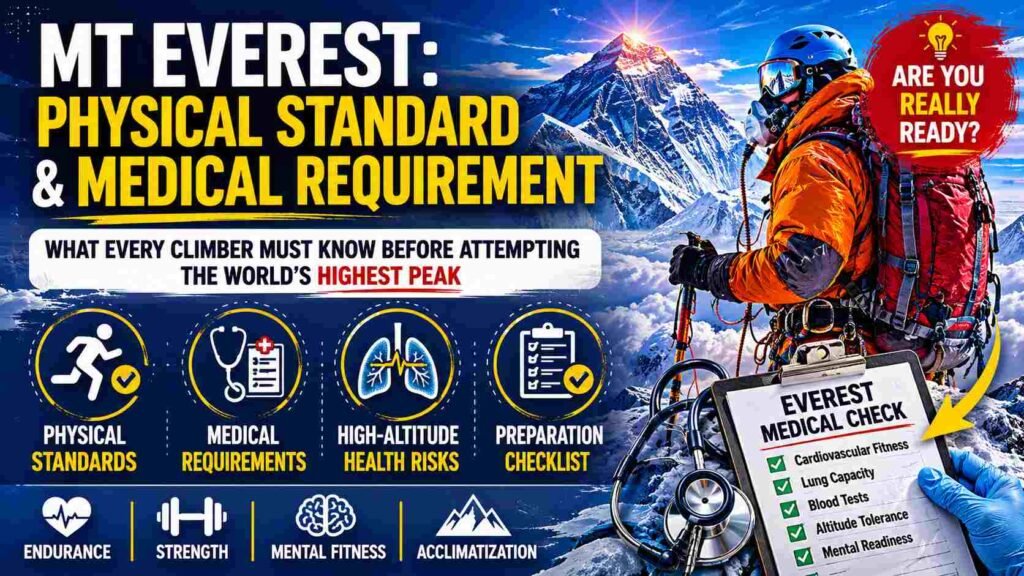
- 🏔️ Why Mount Everest Is Extremely Dangerous
- 💪 Basic Physical Standard for Everest Climbers
- 🫀 Cardiovascular Fitness Matters Most
- 🖼️ Everest Climbing Preparation and High-Altitude Training
- 🏋️ Strength Training Still Plays an Important Role
- 🧠 Mental Strength Is Equally Important
- 🩺 Medical Requirements Before Climbing Everest
- ❤️ Heart Health Critically Important
- 🫁 Lung Function and Oxygen Capacity
- 🧪 Blood Tests and General Health Screening
- ❄️ Frostbite and Cold Tolerance
- 🧗 Previous High-Altitude Experience Matters Enormously
- ⚠️ Altitude Sickness Can Become Deadly
- 🌍 The Commercialization of Everest Raises Concerns
- 🧘 Recovery After Everest Expeditions
- ❤️ Final Thoughts
- FAQs About Everest Physical Standards and Medical Requirements
Climbing Mount Everest remains one of the most difficult physical and mental challenges on Earth. Every year, adventurers from around the world attempt to stand on the highest peak above sea level. However, many people underestimate the brutal physical demands and strict medical preparation required before attempting the climb.
Mount Everest is not simply a trekking adventure.
Instead, it pushes the human body to extreme limits involving:
- Low oxygen levels
- Freezing temperatures
- Severe exhaustion
- High-altitude illness
- Mental stress
Consequently, proper physical standards and medical screening become absolutely essential for survival and success.
Although social media often glamorizes Everest expeditions, experienced climbers understand the mountain can quickly become deadly without adequate preparation.
So, what physical fitness level and medical condition do climbers actually need before attempting Everest?
This detailed guide explains the physical standards, medical requirements, training expectations, health risks, altitude challenges, and preparation strategies needed for climbing Mount Everest safely.
🏔️ Why Mount Everest Is Extremely Dangerous
At 8,848.86 meters (29,031 feet), Mount Everest exposes climbers to one of the harshest environments on Earth.
The mountain presents:
- Extremely low oxygen
- Violent weather changes
- Avalanche risks
- Frostbite danger
- Exhaustion
- Altitude sickness
⚠️ Above 8,000 meters lies the “death zone,” where oxygen levels become critically low for human survival.
Consequently, even healthy climbers may struggle physically and mentally.
💪 Basic Physical Standard for Everest Climbers
Many people ask whether ordinary gym fitness is enough for Everest.
The answer is no.
🏃 Everest climbers need exceptional endurance rather than just muscular strength.
Most successful climbers train for:
- Cardiovascular endurance
- Leg strength
- Core stability
- Lung capacity
- Mental resilience
Additionally, climbers often carry heavy backpacks while trekking for multiple days in harsh conditions.
🫀 Cardiovascular Fitness Matters Most
Strong cardiovascular health becomes one of the most important physical requirements.
Climbers must handle:
- Long uphill climbs
- Oxygen deprivation
- Multi-hour trekking days
❤️ Consequently, heart and lung efficiency play a major role in survival at high altitude.
Many mountaineers train through:
- Running
- Cycling
- Stair climbing
- Hiking with weighted packs
Endurance conditioning often takes many months or even years.
🖼️ Everest Climbing Preparation and High-Altitude Training

🏔️ Everest climbers require extensive endurance training, medical preparation, and high-altitude experience before attempting the summit.
🏋️ Strength Training Still Plays an Important Role
Although endurance matters most, strength training remains essential.
💪 Climbers need strong:
- Legs
- Back muscles
- Core muscles
- Shoulders
These muscle groups help manage:
- Steep ascents
- Ice climbing
- Backpack loads
- Ladder crossings
However, excessive bodybuilding mass may actually reduce endurance performance at altitude.
Consequently, functional strength becomes more valuable than appearance-focused muscle training.
🧠 Mental Strength Is Equally Important
Everest challenges the mind as much as the body.
Climbers face:
- Fear
- Fatigue
- Isolation
- Sleep deprivation
- Harsh weather
- Extreme stress
🧠 Consequently, mental resilience often determines whether climbers continue safely or make dangerous decisions under pressure.
Experienced mountaineers train psychologically through:
- Long expeditions
- Survival training
- High-pressure environments
🩺 Medical Requirements Before Climbing Everest
Most expedition companies require detailed medical evaluations before approving climbers.
Doctors commonly assess:
- Heart health
- Lung function
- Blood pressure
- Oxygen capacity
- Previous illnesses
⚕️ Certain medical conditions may significantly increase danger during high-altitude climbing.
Therefore, climbers usually undergo comprehensive health screenings.
❤️ Heart Health Critically Important
High altitude places enormous stress on the cardiovascular system.
Consequently, people with:
- Severe heart disease
- Uncontrolled hypertension
- Cardiac rhythm disorders
may face serious complications on Everest.
🫀 Doctors often recommend stress tests and ECG evaluations before approving extreme altitude expeditions.
🫁 Lung Function and Oxygen Capacity

Air pressure decreases dramatically at extreme altitude.
As a result, the body receives far less oxygen with every breath.
🫁 Climbers with severe:
- Asthma
- Chronic lung disease
- Respiratory weakness
may struggle significantly at altitude.
Although some individuals with controlled asthma climb successfully, pulmonary evaluations remain extremely important.
🧪 Blood Tests and General Health Screening
Expedition medical checks often include:
- Blood testing
- Kidney function assessment
- Liver evaluation
- Hemoglobin levels
🧬 Good overall health helps the body tolerate:
- Cold exposure
- Altitude stress
- Physical exhaustion
Even minor health problems may worsen dramatically on Everest.
❄️ Frostbite and Cold Tolerance
Temperatures on Everest may fall below -30°C (-22°F) or lower.
Consequently, climbers risk:
- Frostbite
- Hypothermia
- Tissue damage
🧤 Proper cold-weather gear becomes absolutely essential.
Additionally, climbers must understand how their bodies respond to freezing conditions during long expeditions.
🧗 Previous High-Altitude Experience Matters Enormously
Most reputable guides strongly prefer climbers with prior mountaineering experience.
🏔️ Many Everest climbers first summit:
- Mount Kilimanjaro
- Aconcagua
- Denali
These climbs help people understand:
- Altitude effects
- Expedition life
- Technical climbing
- Endurance demands
Without prior experience, Everest becomes significantly more dangerous. Everest physical standard demands high level of fitness from it’s contenders.
⚠️ Altitude Sickness Can Become Deadly
Altitude sickness remains one of the biggest dangers on Everest.
Symptoms may include:
- Headaches
- Nausea
- Dizziness
- Confusion
- Breathlessness
🚨 Severe altitude illness may progress into:
- High Altitude Pulmonary Edema (HAPE)
- High Altitude Cerebral Edema (HACE)
Both conditions can become fatal quickly.
Consequently, climbers must recognize symptoms early.
🧴 Nutrition and Hydration During Everest Expeditions
At high altitude, the body burns enormous amounts of energy.
🍲 Climbers require:
- High-calorie meals
- Electrolytes
- Frequent hydration
Unfortunately, appetite often decreases at altitude.
Consequently, maintaining nutrition becomes surprisingly difficult during expeditions.
💤 Sleep Problems Are Extremely Common
Many Everest climbers struggle with:
- Poor sleep
- Interrupted breathing
- Insomnia
😴 Reduced oxygen levels frequently disrupt normal sleep patterns.
Consequently, exhaustion accumulates rapidly during multi-week expeditions.
🚑 Emergency Medical Support Is Limited
Although Everest expeditions include support teams, advanced emergency care remains difficult in remote mountain environments.
🚁 Helicopter evacuations may help lower-altitude emergencies, although severe weather often limits rescue operations.
Consequently, prevention and preparation become far more important than relying on rescue services.
📈 Everest Climbers Are Getting Older
Interestingly, more older climbers now attempt Everest expeditions.
However, age alone does not determine success.
🧓 Some older climbers succeed because they maintain:
- Excellent endurance
- Strong cardiovascular health
- Years of mountaineering experience
Nevertheless, medical evaluations become increasingly important with age.
🌍 The Commercialization of Everest Raises Concerns

Modern Everest expeditions have become more commercially accessible.
Consequently, critics worry some climbers attempt Everest without sufficient:
- Fitness
- Experience
- Medical preparation
⚠️ Crowding on the mountain may increase risks for everyone involved.
Experienced mountaineers often emphasize preparation over social media achievement goals.
🧘 Recovery After Everest Expeditions
The body may require weeks or months to fully recover after Everest climbs.
Common recovery challenges include:
- Muscle loss
- Fatigue
- Weight loss
- Joint pain
🩺 Some climbers also experience lingering respiratory effects after prolonged high-altitude exposure.
❤️ Final Thoughts
Climbing Mount Everest requires far more than courage or ambition. Successful climbers need exceptional endurance, strong cardiovascular health, mental resilience, technical mountaineering experience, and comprehensive medical preparation.
Although Everest attracts adventurers seeking personal achievement, the mountain remains unforgiving toward poor preparation.
Most importantly, climbers should respect the extreme physical demands and health risks associated with high-altitude mountaineering.
For those properly trained and medically fit, Everest may represent one of the greatest adventures on Earth. However, preparation often determines whether the experience becomes inspiring — or life-threatening.
FAQs About Everest Physical Standards and Medical Requirements
Do you need to be extremely fit to climb Everest?
Yes. Everest requires exceptional endurance, cardiovascular fitness, and mountaineering preparation.
Can beginners climb Mount Everest?
Technically yes, although experts strongly recommend prior high-altitude climbing experience.
What medical tests are required before Everest expeditions?
Doctors commonly evaluate heart health, lung function, blood pressure, bloodwork, and overall physical fitness.
What is the death zone on Everest?
The death zone refers to altitudes above 8,000 meters where oxygen levels become critically low.
Can people with asthma climb Everest?
Some individuals with controlled asthma have climbed successfully, although medical clearance remains essential.
How long does Everest training usually take?
Many climbers train seriously for one to three years before attempting Everest.
Is oxygen required on Everest?
Most climbers use supplemental oxygen near the summit.
What is the biggest danger on Everest?
Major dangers include altitude sickness, exhaustion, avalanches, frostbite, and severe weather.
This article has been made with the help of AI for better SEO but the research and inputs have been provided by me. Sources cited below.
- National Geographic – Mount Everest Coverage
- The Himalayan Database
- Centers for Disease Control and Prevention – High Altitude Travel
- Mayo Clinic – Altitude Sickness
- American Alpine Club
- Adventure Consultants – Everest Expedition Information
You may also like to read other health related articles here also authored by me :
Gym Herpes Outbreak? How to Stay Safe While Working Out
Can Apple Cider Vinegar Help Weight Loss Journey?
Mewing Explained: Does This Viral Jawline Trend Actually Work?
What Your Hands Are Warning You About Your Heart: Hidden Signs