
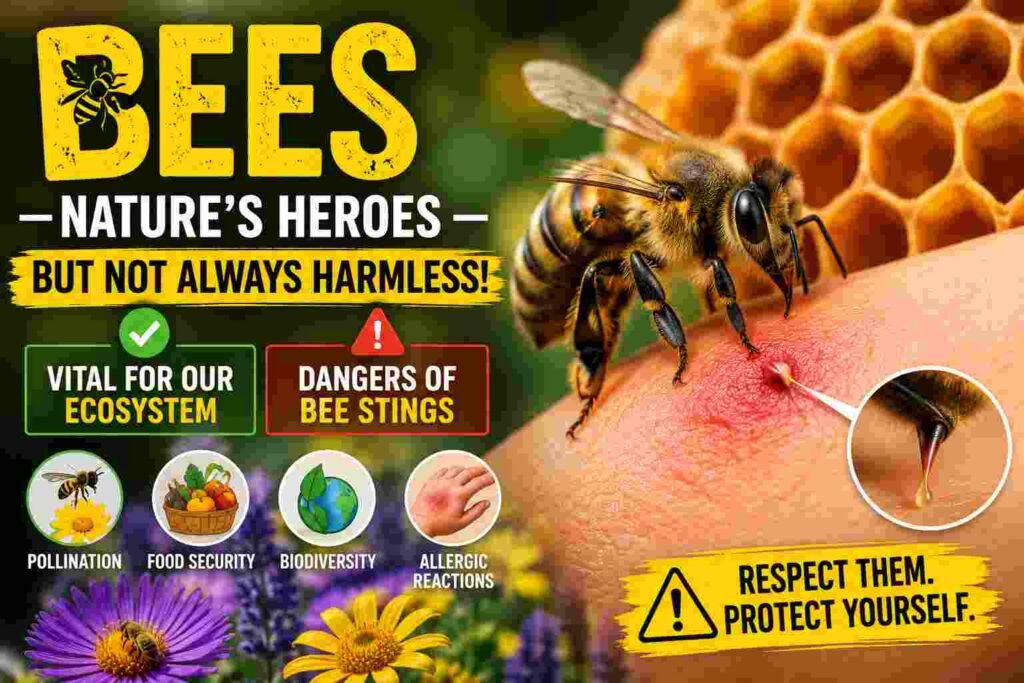
- 🐝 Bees and Human Safety: Why Bees Matter to the Ecosystem
- 🌼 The Hidden Role Bees Play in Nature
- ⚠️ Why Bees Sting Humans
- 🩺 The Real Dangers of Bee Stings
- 🧠 Why Bees Become Aggressive Sometimes
- 🌍 Why Bee Populations Are Declining
- 🍯 The Economic Importance of Bees
- 🏡 How to Stay Safe Around Bees
- 🚨 What To Do After a Bee Sting
- 🌸 Bees and Human Safety: How We Can Protect Bees Responsibly
- FAQs
Bees may look small and harmless at first glance, yet they play one of the biggest roles in maintaining life on Earth. Without bees, ecosystems would collapse faster, food production would suffer dramatically, and biodiversity would decline across the planet. However, while bees support agriculture and pollinate millions of plants every day, they can also become dangerous when they feel threatened.
For most people, a bee sting causes temporary pain and swelling. Nevertheless, for others, a sting can trigger severe allergic reactions that may become life-threatening within minutes. Therefore, understanding both the importance of bees and the risks they pose remains essential.
In this article, we will explore why bees matter so much to our ecosystem, how they help humans survive, why they sting when angry, and how people can stay safe around them without harming these vital pollinators.
🐝 Bees and Human Safety: Why Bees Matter to the Ecosystem
Bees contribute enormously to the natural world because they pollinate flowering plants. Pollination occurs when bees transfer pollen from one flower to another, allowing plants to reproduce successfully.
Although wind and other insects also help with pollination, bees perform this task more efficiently than most species. Consequently, they support the growth of fruits, vegetables, nuts, seeds, and wild plants.
In fact, scientists estimate that bees help pollinate around one-third of the food humans consume regularly.
Some important crops that depend heavily on bees include:
- Apples
- Almonds
- Blueberries
- Cucumbers
- Pumpkins
- Coffee
- Watermelons
Without bees, farmers would struggle to maintain current food production levels. As a result, food prices could rise sharply while global hunger might worsen.
Moreover, bees also support forests, grasslands, and wildlife habitats because pollinated plants provide food and shelter for countless animals.
🌼 The Hidden Role Bees Play in Nature
Many people associate bees only with honey production. However, their ecological value extends far beyond honey.
Bees help maintain biodiversity by supporting plant reproduction across ecosystems. Consequently, birds, insects, mammals, and even aquatic life benefit indirectly from bee activity.
For example, flowering plants produce seeds and fruits after pollination. Those seeds then feed animals, while plant roots stabilize soil and reduce erosion.
Additionally, healthy plant life improves air quality by absorbing carbon dioxide and releasing oxygen.
Therefore, bees influence climate stability, food chains, and environmental health simultaneously.
Because of this, scientists often describe bees as “keystone pollinators.”
⚠️ Why Bees Sting Humans
Although bees usually avoid humans, they will defend themselves aggressively when threatened.
Bees sting mainly for protection. Worker bees protect their hive, queen, and food supply whenever danger approaches. Consequently, sudden movements, loud vibrations, or attempts to disturb a hive may trigger defensive behavior.
Several situations commonly anger bees:
- Swatting at them
- Disturbing their hive
- Strong perfumes
- Sudden movements
- Loud machinery
- Dark-colored clothing near hives
Moreover, bees communicate danger through chemical signals called pheromones. Once one bee stings, nearby bees may become more aggressive as well.
Therefore, staying calm around bees greatly reduces the chance of getting stung.
🩺 The Real Dangers of Bee Stings
For most individuals, a bee sting causes:
- Sharp pain
- Redness
- Swelling
- Itching
However, some people experience severe allergic reactions known as anaphylaxis.
🚑 Anaphylaxis can develop rapidly and may include:
- Difficulty breathing
- Swelling of the throat
- Dizziness
- Rapid heartbeat
- Low blood pressure
- Loss of consciousness
Without immediate treatment, severe allergic reactions can become fatal.
Additionally, multiple bee stings can overwhelm the body even in people without allergies. Therefore, large bee attacks require emergency medical attention.
Children, elderly individuals, and people with existing respiratory conditions may face higher risks during severe sting incidents.
🧠 Why Bees Become Aggressive Sometimes
Not all bees behave aggressively all the time.
Honeybees usually remain calm while gathering nectar from flowers. However, defensive behavior increases when bees believe their colony faces danger.
Africanized honeybees, sometimes called “killer bees,” react more aggressively than regular honeybees. These bees spread through parts of the Americas after scientists accidentally released hybrid bees in Brazil during the 1950s.
Although their venom is not stronger, they attack in larger numbers and chase threats longer distances.
Meanwhile, solitary bees rarely sting humans because they do not defend large colonies.
Therefore, bee behavior often depends on species, environment, and perceived threats.
🌍 Why Bee Populations Are Declining
Unfortunately, bee populations worldwide continue declining at alarming rates.
Several major factors contribute to this crisis:
- Pesticide use
- Climate change
- Habitat destruction
- Pollution
- Diseases and parasites
- Monoculture farming
🌱 Modern agriculture often removes wildflower habitats that bees need for survival. At the same time, pesticides can weaken bee immune systems and disrupt navigation abilities.
Climate change also affects flowering seasons. Consequently, bees sometimes emerge when flowers are unavailable.
If bee populations continue collapsing, ecosystems and food systems could face devastating consequences.
Therefore, protecting bees now remains extremely important for future environmental stability.
🍯 The Economic Importance of Bees
Bees do not just support nature — they also strengthen economies worldwide.
Pollination services contribute billions of dollars annually to global agriculture. Farmers depend heavily on bees for crop quality, size, and productivity.
For example, almond farming relies almost entirely on bee pollination.
Without sufficient bee populations:
- Crop yields would fall
- Food prices would increase
- Agricultural jobs could decline
- Food shortages might worsen
Additionally, honey production, beeswax products, cosmetics, and medicinal products create valuable industries globally.
Therefore, bees support both environmental and economic sustainability.
🏡 How to Stay Safe Around Bees
Fortunately, people can usually avoid bee stings by following simple safety measures.
🐝 Helpful bee safety tips include:
- Stay calm near bees
- Avoid swatting at them
- Wear light-colored clothing outdoors
- Keep sugary drinks covered
- Avoid disturbing hives
- Use caution near flowering plants
If a bee lands on you, remain still or gently brush it away slowly.
Additionally, homeowners should contact professional beekeepers instead of destroying bee colonies unnecessarily.
Many local beekeepers safely relocate hives without harming bees or humans.
🚨 What To Do After a Bee Sting
Quick action after a sting can reduce discomfort and prevent complications.
First, remove the stinger carefully because it continues releasing venom briefly after the sting.
Then:
- Wash the area
- Apply ice
- Elevate swollen limbs
- Use antihistamines if needed
- Monitor symptoms closely
However, seek emergency medical help immediately if symptoms include breathing difficulty, facial swelling, or dizziness.
People with severe allergies should always carry an epinephrine auto-injector prescribed by their doctor.
🌸 Bees and Human Safety: How We Can Protect Bees Responsibly
Protecting bees does not mean ignoring safety concerns.
Instead, humans can support pollinators while maintaining safe boundaries.
Simple ways to help bees include:
- Planting native flowers
- Reducing pesticide use
- Supporting local beekeepers
- Creating pollinator gardens
- Preserving natural habitats
Additionally, educating children about respectful behavior around bees reduces unnecessary fear and dangerous interactions.
Because bees rarely sting without reason, peaceful coexistence often works best.
🧬 The Difference Between Bees and Wasps
Many people confuse bees with wasps, although their behavior differs significantly.
Bees usually focus on pollination and nectar collection. Consequently, they tend to appear less aggressive unless threatened.
Wasps, however, behave more predatory and territorial.
Unlike bees:
- Wasps can sting multiple times
- Bees often die after stinging
- Wasps actively hunt insects
- Bees prefer flowers and pollen
Understanding these differences helps people respond more calmly during insect encounters.
🌎 Why the Future of Bees Matters to Humanity
The future of bees directly affects the future of humanity.
Without pollinators, ecosystems weaken rapidly. Consequently, biodiversity decreases, crop production declines, and food insecurity grows worldwide.
At the same time, fear of bee stings sometimes causes unnecessary hive destruction.
Therefore, balancing conservation with public safety remains essential.
Scientists, environmental groups, farmers, and communities must work together to protect pollinator populations responsibly while educating people about sting prevention and allergy awareness.
Ultimately, bees deserve respect — not fear or careless destruction.
🌟 Final Thoughts
Bees represent one of nature’s most valuable species. They support ecosystems, sustain agriculture, strengthen biodiversity, and contribute enormously to global food production. Without them, life on Earth would change dramatically.
However, bee stings can also pose serious dangers, especially for individuals with allergies or during aggressive hive encounters. Therefore, awareness and caution remain important.
Fortunately, humans can coexist safely with bees by respecting their space, understanding their behavior, and supporting conservation efforts responsibly.
In the end, bees are not simply insects buzzing around flowers. They are essential workers quietly helping life flourish every single day.
FAQs
❓Why are bees important to the ecosystem?
Bees pollinate plants, fruits, vegetables, and crops. Consequently, they support biodiversity, food production, and environmental stability.
❓Why do bees sting humans?
Bees sting mainly to defend themselves or protect their hive when they feel threatened.
❓Can a bee sting kill someone?
Yes, severe allergic reactions called anaphylaxis can become life-threatening without immediate treatment.
❓What should I do if a bee stings me?
Remove the stinger, wash the area, apply ice, and monitor symptoms. Seek emergency help if breathing problems or severe swelling occur.
❓Are all bees aggressive?
No. Most bees remain calm unless disturbed. Honeybees generally sting only when defending their hive.
❓Why are bee populations declining?
Pesticides, habitat destruction, climate change, pollution, and diseases all contribute to declining bee populations.
❓How can people help protect bees?
Planting flowers, reducing pesticide use, supporting local beekeepers, and preserving habitats all help bee populations thrive.
This article has been made with the help of AI for better SEO but the research and inputs have been provided by me. Sources cited below.
- World Health Organization (WHO) – Insect Sting Allergies and Health Information
- United States Environmental Protection Agency (EPA) – Protecting Pollinators
- Food and Agriculture Organization (FAO) – Importance of Pollinators
- National Geographic – Why Bees Are Important to the Planet
- Centers for Disease Control and Prevention (CDC) – Bee Sting Allergy and Emergency Care
- Smithsonian Institution – The Global Importance of Bees
You may also like to read other health related articles here also authored by me :
Simi Valley Fire: How to Protect Yourself in Such Situations
Amy Schumer Opens Up About ‘Botched’ Medical Procedure
Silent Signs of Dementia: Early Symptoms Many Families Overlook
Warm Lemon Water: First Thing You Should Take After Waking Up?
HRSA Community Health Centre: #cheapermedicare
Tecentriq SC Injection: The New 7-Minute Cancer Shot for Patients