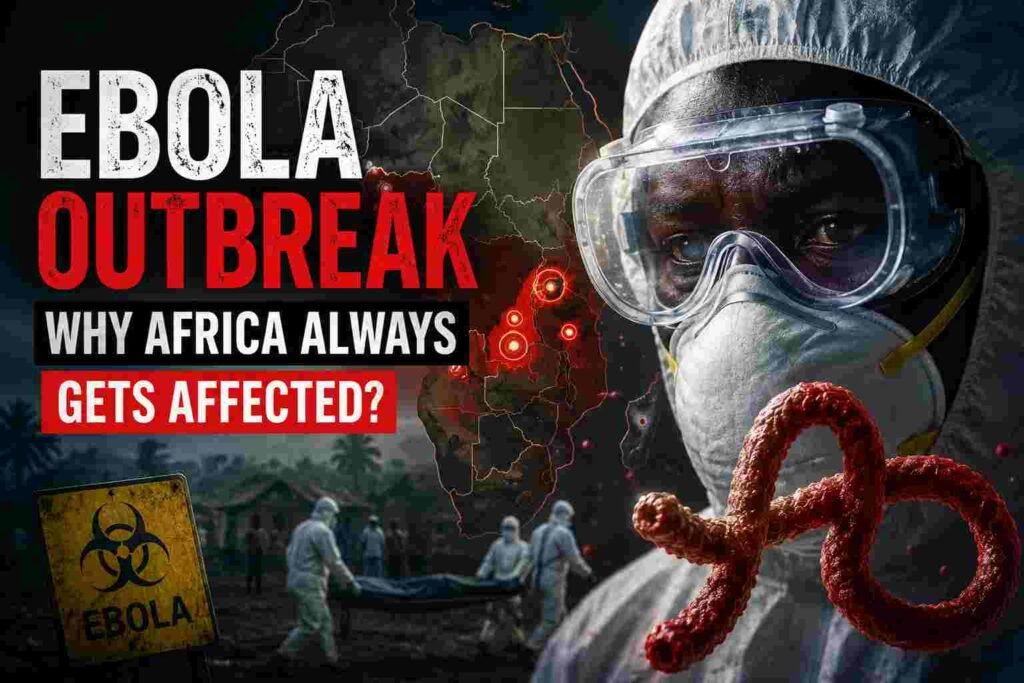
- 🚨 The Latest Ebola Outbreak in Africa: What Is Happening Right Now?
- 🦠 Understanding the Ebola Outbreak
- 🌍 Why Ebola Outbreaks Mostly Happen in Africa
- 🧬 Why Ebola Rarely Becomes a Global Pandemic
- 🚑 The Role of Vaccines and Medical Advances
- ⚠️ Conflict and Political Instability Increase Ebola Risks
- 🌱 Climate Change and Environmental Factors
- 🤝 Why Ebola Is a Global Responsibility
- 📚 Lessons Learned From Past Ebola Outbreaks
- 🔬 Could Ebola Spread Beyond Africa in the Future?
- 🧠 Final Thoughts on the Ebola Outbreak
- FAQs About Ebola Outbreaks
When people hear about an Ebola outbreak, one continent often comes to mind first — Africa. Over the years, deadly Ebola outbreaks have repeatedly emerged in several African countries, causing fear, economic damage, and heartbreaking loss of life. However, many people still ask the same question: Why does Ebola continue to affect Africa more than other regions of the world?
The answer is far more complex than many headlines suggest. Ebola does not spread because of one single reason. Instead, geography, healthcare systems, climate, poverty, wildlife interaction, and global inequality all play major roles. Moreover, weak infrastructure and delayed international responses often make outbreaks worse.
In this article, we will explore the real reasons behind recurring Ebola outbreaks in Africa, how the virus spreads, why certain regions remain vulnerable, and what the world can do to prevent future epidemics.
🚨 The Latest Ebola Outbreak in Africa: What Is Happening Right Now?
The latest Ebola outbreak in Central Africa has once again placed global health agencies on high alert. In May 2026, the World Health Organization (WHO) officially declared the ongoing Ebola crisis in the Democratic Republic of Congo (DRC) and neighboring Uganda a “Public Health Emergency of International Concern.” This declaration came after health officials reported a rapidly increasing number of suspected infections and deaths linked to the rare Bundibugyo strain of the Ebola virus.
This new strain of Ebola is different
Unlike previous outbreaks caused by the Zaire strain, this version currently has no approved vaccine or specific treatment, which has significantly increased worldwide concern. According to WHO and CDC reports, hundreds of suspected cases and more than 80 deaths were initially recorded in the Ituri Province of northeastern Congo, although the numbers have continued to rise as testing and surveillance expanded. More recent updates suggest that suspected cases may already exceed 500, while deaths have crossed 130 in some affected areas.
Cause of concern
🧬 What makes this outbreak particularly alarming is the speed at which the virus has spread beyond remote villages into larger urban centers. Health authorities confirmed cases not only in eastern Congo but also in Uganda’s capital Kampala after an infected traveler crossed the border from the DRC. Consequently, fears of regional transmission have intensified across Central and East Africa. WHO officials have repeatedly warned that conflict zones, population displacement, and weak healthcare systems are making containment efforts extremely difficult.
In several outbreak regions, hospitals lack proper testing equipment, protective gear, and isolation wards. Moreover, healthcare workers themselves have become infected, showing that hospitals remain vulnerable transmission points. Reuters and WHO reports also revealed that laboratories currently struggle to process enough tests for the Bundibugyo strain because most existing diagnostic systems were originally designed for the more common Zaire Ebola strain. As a result, delays in diagnosis may have allowed the virus to spread silently during the early stages of the outbreak.
🌍 Another major concern involves the humanitarian situation inside the Democratic Republic of Congo. The outbreak has emerged in regions already suffering from armed conflict, poverty, food shortages, and mass displacement. Thousands of people regularly move between villages, refugee settlements, mining areas, and neighboring countries, which makes contact tracing far more difficult. Furthermore, medical teams often face security risks while entering conflict-affected zones.
International aid organizations, including WHO, Africa CDC, and Médecins Sans Frontières, have already deployed emergency personnel, medical supplies, and surveillance teams to affected regions. WHO has also released emergency funding to support rapid response operations. However, officials warn that funding shortages continue slowing containment efforts. Some humanitarian agencies report receiving only a fraction of the financial support needed to manage the growing crisis effectively.
This is not a Covid like situation
⚠️ Although WHO has declared the outbreak a global health emergency, experts emphasize that Ebola is not currently considered a pandemic threat like COVID-19. Ebola spreads through direct contact with infected bodily fluids rather than airborne transmission. Nevertheless, global travel and porous borders still create risks for international spread. Therefore, countries worldwide have increased airport screening, surveillance, and emergency preparedness measures.
The U.S. CDC has already activated emergency response systems and issued public health advisories for travelers and healthcare providers. Meanwhile, scientists are urgently evaluating experimental vaccines and treatments that may work against the Bundibugyo strain. Researchers hope that lessons learned from earlier Ebola epidemics will help authorities contain the virus more quickly this time. Still, public health experts continue warning that without rapid international cooperation, stronger healthcare infrastructure, and sustained funding, the outbreak could worsen further in the coming weeks.
🦠 Understanding the Ebola Outbreak
An Ebola outbreak occurs when the Ebola virus spreads rapidly among humans. The virus causes severe fever, bleeding, organ failure, and, in many cases, death. Scientists first discovered Ebola in 1976 near the Ebola River in what is now the Democratic Republic of Congo.
Since then, several African nations have faced repeated outbreaks, including:
- Democratic Republic of Congo
- Uganda
- Guinea
- Sierra Leone
- Liberia
- Sudan
Although Ebola is highly dangerous, it does not spread through the air like influenza or COVID-19. Instead, the virus spreads through direct contact with infected bodily fluids such as blood, saliva, sweat, vomit, or contaminated surfaces.
Because of this, outbreaks often begin in isolated communities before expanding into larger towns and cities.
🌍 Why Ebola Outbreaks Mostly Happen in Africa
1. Close Human Contact With Wildlife
One of the biggest reasons Africa experiences repeated Ebola outbreaks involves human interaction with wildlife.
Scientists believe fruit bats carry the Ebola virus naturally. In many rural African regions, people live close to forests where infected animals such as bats, monkeys, and chimpanzees are common. Consequently, hunting and handling bushmeat increases the risk of virus transmission.
In some communities, families depend on forest animals for food and survival. Therefore, avoiding contact with wildlife becomes difficult.
Additionally, deforestation has pushed humans deeper into animal habitats. As forests disappear, humans and infected animals interact more frequently, increasing the likelihood of virus spillover.
2. Weak Healthcare Infrastructure
🏥 Another major reason involves fragile healthcare systems.
Many African countries affected by Ebola struggle with limited medical resources. Hospitals often lack:
- Protective equipment
- Isolation wards
- Laboratory facilities
- Trained healthcare workers
- Emergency transportation
As a result, doctors and nurses sometimes become infected while treating patients. Furthermore, rural clinics may not detect Ebola quickly enough, allowing the virus to spread silently.
For example, during the 2014–2016 West African Ebola outbreak, overwhelmed hospitals struggled to manage thousands of patients. Consequently, the epidemic became the deadliest Ebola outbreak in history.
3. Poverty and Limited Public Awareness
💡 Poverty also contributes heavily to Ebola outbreaks.
In poorer regions, many people lack access to clean water, sanitation, and healthcare information. Therefore, communities may not immediately recognize Ebola symptoms or understand how the virus spreads.
Moreover, misinformation can create fear and distrust. In some cases, people avoid hospitals because they fear isolation or death. Others may rely on traditional healers instead of seeking medical care.
Because of this, infected individuals sometimes remain within communities instead of receiving early treatment.
Additionally, crowded living conditions make infection control more difficult.
4. Traditional Burial Practices
Funeral traditions play a surprisingly important role during an Ebola outbreak.
In several African cultures, family members wash and touch the body of a deceased loved one as part of funeral rituals. Unfortunately, Ebola remains highly contagious after death.
Consequently, one funeral can infect dozens of people if safety precautions are not followed.
Health authorities often face challenges when trying to balance public safety with cultural respect. Nevertheless, community education programs have helped reduce transmission during recent outbreaks.
5. Delayed Global Response
🌐 Another reason Africa suffers repeatedly involves slow international action.
Historically, global attention toward Ebola outbreaks often arrives late. In many cases, wealthier nations mobilize resources only after outbreaks become severe.
This delay creates serious consequences. By the time vaccines, doctors, and emergency funding arrive, the virus may already have spread widely.
Furthermore, some critics argue that diseases affecting poorer nations receive less urgency compared to outbreaks in wealthier countries.
Although international organizations now respond faster than before, major gaps still remain.
🧬 Why Ebola Rarely Becomes a Global Pandemic
Many people wonder why Ebola outbreaks remain mostly concentrated in Africa instead of spreading worldwide.
Several factors help limit global transmission:
- Ebola symptoms appear quickly
- Severely ill patients often cannot travel far
- The virus requires direct contact
- Healthcare systems in wealthier nations usually isolate cases rapidly
However, this does not mean the world is completely safe.
Global travel continues to increase every year. Therefore, one infected traveler can still carry the virus internationally. In fact, isolated Ebola cases have appeared outside Africa in the past.
Because of this, global monitoring remains extremely important.
🚑 The Role of Vaccines and Medical Advances
Fortunately, medical science has made major progress against Ebola.
Researchers developed effective Ebola vaccines after the devastating West African outbreak. These vaccines now help contain outbreaks more quickly than before.
Additionally, doctors use improved protective gear, rapid testing systems, and better treatment protocols. Consequently, survival rates have improved in many regions.
Still, vaccine distribution remains uneven. Remote communities often face transportation and storage challenges, especially in conflict zones.
Therefore, healthcare access continues to determine how effectively outbreaks get controlled.
⚠️ Conflict and Political Instability Increase Ebola Risks
In several African nations, political instability makes Ebola containment far more difficult.
War zones and armed conflicts disrupt hospitals, supply chains, and vaccination campaigns. Moreover, healthcare workers sometimes face attacks or threats while trying to help communities.
For example, eastern Democratic Republic of Congo has experienced both armed violence and Ebola outbreaks simultaneously. Under such conditions, tracking infections to contain ebola outbreak in Africa as a whole becomes extremely challenging.
As a result, the virus can spread longer before authorities contain it.
🌱 Climate Change and Environmental Factors
🌿 Climate change may also influence future Ebola outbreaks.
Scientists believe changing temperatures and rainfall patterns could alter animal migration and habitat distribution. Consequently, humans may encounter virus-carrying animals more frequently.
At the same time, deforestation and mining activities continue expanding across tropical forests. These environmental changes increase contact between humans and wildlife reservoirs.
Although researchers still study the exact relationship, many experts believe environmental disruption raises the risk of future outbreaks.
🤝 Why Ebola Is a Global Responsibility
Many people wrongly assume Ebola only concerns Africa. In reality, infectious diseases affect the entire world.
Modern travel allows viruses to cross borders quickly. Therefore, stronger healthcare systems in Africa protect global health as well.
Wealthier nations can help by:
- Funding healthcare infrastructure
- Supporting vaccine research
- Training medical workers
- Improving emergency response systems
- Supporting disease surveillance programs
Moreover, fair global partnerships matter more than temporary crisis interventions.
Instead of reacting only during emergencies, the world must invest in long-term public health systems.
📚 Lessons Learned From Past Ebola Outbreaks
Every Ebola outbreak has taught the following valuable lessons.
Communities Matter Most
Outbreaks become easier to control when local communities trust healthcare workers. Therefore, public education and communication remain essential.
Fast Action Saves Lives
Rapid testing, isolation, and vaccination reduce transmission significantly. Consequently, early response systems are critical.
Strong Healthcare Systems Prevent Disaster
Countries with stronger hospitals and surveillance systems usually contain outbreaks faster. Investment in healthcare infrastructure therefore remains one of the best long-term solutions.
Global Cooperation Is Essential
Viruses do not respect borders. As a result, international collaboration becomes necessary during health emergencies.
🔬 Could Ebola Spread Beyond Africa in the Future?
Although Ebola outbreak in Africa remains the primary hotspot, experts do not rule out future outbreaks elsewhere.
Environmental destruction, climate change, and global travel increase worldwide disease risks. Additionally, animal reservoirs exist in other regions too.
However, countries with stronger healthcare systems generally respond faster and isolate infections more effectively.
Even so, the COVID-19 pandemic showed how quickly global outbreaks can spiral when preparedness fails.
Therefore, continuous monitoring and investment remain crucial.
🧠 Final Thoughts on the Ebola Outbreak
The repeated Ebola outbreak crisis in Africa does not happen because the continent is uniquely vulnerable by nature. Instead, historical inequality, fragile healthcare systems, environmental pressures, poverty, and delayed global action all contribute heavily.
At the same time, African scientists, healthcare workers, and communities have shown remarkable resilience during countless outbreaks. Their efforts continue saving lives under extremely difficult conditions.
Moving forward, the world must stop viewing Ebola as “Africa’s problem.” Infectious diseases threaten everyone. Therefore, global health security depends on stronger healthcare systems, faster cooperation, scientific research, and sustainable development.
Only then can future Ebola outbreaks become less deadly and less frequent.
FAQs About Ebola Outbreaks
❓What causes an Ebola outbreak?
An Ebola outbreak begins when the Ebola virus spreads from infected animals to humans and then between humans through direct contact with bodily fluids.
❓Why is Ebola mostly found in Africa?
Ebola outbreak in Africa occurs mainly because several regions have close human-wildlife interaction, tropical forests, weak healthcare systems, and limited medical infrastructure.
❓Can Ebola spread through the air?
No, Ebola does not spread through the air like the flu or COVID-19. Instead, it spreads through direct physical contact with infected fluids or contaminated surfaces.
❓Is there a cure for Ebola?
There is no single guaranteed cure. However, vaccines, supportive medical care, hydration, and early treatment significantly improve survival rates.
❓Which African country suffered the worst Ebola outbreak?
The 2014–2016 Ebola outbreak in Western Africa heavily affected Guinea, Liberia, and Sierra Leone and became the deadliest Ebola epidemic in history.
❓Can Ebola become a worldwide pandemic?
Although Ebola can spread internationally, it usually remains easier to contain than airborne viruses because transmission requires direct contact.
❓How can future Ebola outbreaks be prevented?
Prevention requires stronger healthcare systems, faster outbreak detection, vaccination programs, public education, wildlife monitoring, and global cooperation.
This article has been made with the help of AI for better SEO but the research and inputs have been provided by me. Sources cited below.
- World Health Organization (WHO) – Ebola Virus Disease
- Centers for Disease Control and Prevention (CDC) – Ebola Information
- UNICEF – Ebola Response and Awareness
- Médecins Sans Frontières (Doctors Without Borders) – Ebola Crisis Reports
- National Institutes of Health (NIH) – Ebola Research Updates
- World Bank – Economic Impact of Ebola
You may also like to read other health related articles here also authored by me :
Simi Valley Fire: How to Protect Yourself in Such Situations
Amy Schumer Opens Up About ‘Botched’ Medical Procedure
Silent Signs of Dementia: Early Symptoms Many Families Overlook
Warm Lemon Water: First Thing You Should Take After Waking Up?
HRSA Community Health Centre: #cheapermedicare
Tecentriq SC Injection: The New 7-Minute Cancer Shot for Patients