- Why Exercise Helps Knee Pain
- Common Causes of Knee Pain
- Important Tips Before Exercising
- Why Strengthening the Hips Matters
- The Role of Weight Management in Knee Pain
- Can Exercise Help Arthritis Knee Pain?
- When Should You See a Doctor?
- Additional Tips for Healthy Knees
- How Long Does It Take to See Improvement?
- Final Thoughts
Knee pain is one of the most common health problems affecting people of all ages. Whether it’s caused by aging, arthritis, injury, excess weight, prolonged sitting, or intense physical activity, knee pain can make everyday movements feel difficult and frustrating.
Simple activities like walking, climbing stairs, sitting down, or even standing for long periods may suddenly become painful. Many people avoid exercise completely when their knees hurt — but surprisingly, the right exercises can actually reduce knee pain and strengthen the joints.
The key is choosing safe, low-impact movements that improve flexibility, strengthen supporting muscles, and reduce pressure on the knees.
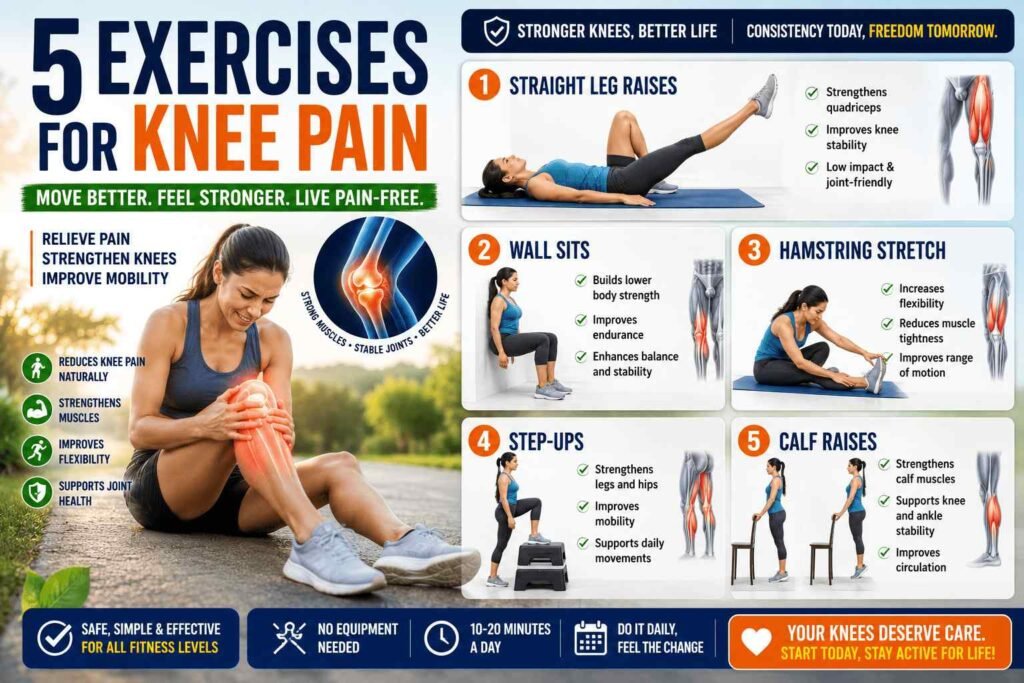
In this article, you’ll discover 5 highly effective exercises for knee pain, how they work, and important tips to protect your knees naturally.
Why Exercise Helps Knee Pain
Many people assume resting the knees completely is the best solution. While short-term rest may help after injury, long-term inactivity can weaken the muscles that support the knees.
Weak muscles around the:
- thighs,
- hips,
- calves,
- and core
can increase stress on the knee joint.
Proper exercises help by:
- improving joint stability,
- increasing flexibility,
- reducing stiffness,
- improving circulation,
- and strengthening surrounding muscles.
Regular movement also helps lubricate the joints, which may reduce discomfort and improve mobility. Please check this authoritative link for more information here.
Common Causes of Knee Pain
Knee pain can develop for many reasons, including:
- osteoarthritis,
- ligament injuries,
- tendon inflammation,
- muscle weakness,
- obesity,
- poor posture,
- or repetitive strain.
Sometimes even prolonged sitting and lack of movement can contribute to stiffness and pain.
Before starting exercises, severe or sudden knee pain should always be evaluated by a healthcare professional.
Important Tips Before Exercising
Before beginning knee exercises:
- move slowly,
- avoid sudden twisting,
- wear supportive shoes,
- and stop if sharp pain occurs.
A mild stretching sensation or slight muscle fatigue is normal, but intense pain is not.
Consistency matters more than intensity.
1. Straight Leg Raises
Straight Leg Raise
Straight leg raises help strengthen the quadriceps muscles without placing heavy pressure on the knee joint.
Strong quadriceps provide better knee support and stability.
How to Do It
- Lie flat on your back.
- Bend one knee while keeping the other leg straight.
- Slowly raise the straight leg about 12 inches off the floor.
- Hold for a few seconds.
- Slowly lower it back down.
Repeat:
- 10–15 repetitions per leg
- for 2–3 sets.
Benefits
- Strengthens thigh muscles
- Improves knee stability
- Reduces pressure on joints
- Low-impact and beginner-friendly
This is often one of the safest exercises for people with knee discomfort.
2. Wall Sits
Wall Sit
Wall sits strengthen the:
- thighs,
- glutes,
- and core
while improving endurance around the knee joint.
How to Do It
- Stand with your back against a wall.
- Slowly slide downward into a seated position.
- Keep knees aligned over ankles.
- Hold the position for 10–30 seconds.
Gradually increase hold time as strength improves.
Benefits
- Builds muscle endurance
- Strengthens knee-supporting muscles
- Improves balance and stability
Avoid lowering too deeply if pain increases.
3. Hamstring Stretch
Hamstring Stretch
Tight hamstrings can place additional stress on the knees.
Stretching these muscles improves flexibility and reduces tension around the joint.
How to Do It
- Sit on the floor with one leg extended.
- Keep your back straight.
- Reach gently toward your toes.
- Hold for 20–30 seconds.
Repeat on both sides.
Benefits
- Improves flexibility
- Reduces muscle tightness
- Enhances mobility
- Supports proper knee movement
Never bounce while stretching.
4. Step-Ups
Step-Up
Step-ups strengthen muscles used during daily activities like climbing stairs.
This exercise targets:
- quadriceps,
- glutes,
- calves,
- and hips.
How to Do It
- Use a low step or platform.
- Step up slowly with one foot.
- Bring the other foot up.
- Step back down carefully.
Repeat:
- 10 repetitions per side.
Benefits
- Improves functional strength
- Enhances balance
- Strengthens multiple muscle groups
- Helps daily mobility
Start with a low step height to avoid strain.
5. Calf Raises
Calf Raise
Strong calves help support proper walking mechanics and reduce stress on the knees.
How to Do It
- Stand upright holding a wall or chair for support.
- Slowly rise onto your toes.
- Hold briefly at the top.
- Lower back down slowly.
Repeat:
- 15–20 repetitions.
Benefits
- Strengthens calf muscles
- Improves ankle stability
- Supports knee alignment
- Enhances walking balance
This simple exercise can be done almost anywhere.
Why Strengthening the Hips Matters
Many people focus only on the knees themselves, but hip strength plays a major role in knee health.
Weak hip muscles may:
- affect posture,
- alter walking patterns,
- and increase knee stress.
Exercises targeting the hips and glutes often help reduce knee discomfort significantly.
The Role of Weight Management in Knee Pain
The knees carry enormous pressure during movement.
Even small amounts of excess body weight increase stress on the joints.
Research suggests that losing weight may:
- reduce knee pain,
- improve mobility,
- and slow joint degeneration.
Exercise combined with healthy nutrition can help protect knee health long-term.
Best Low-Impact Activities for Knee Pain
Besides strengthening exercises, certain activities are especially knee-friendly.
Helpful options include:
- walking,
- swimming,
- cycling,
- yoga,
- and water aerobics.
These activities improve circulation and mobility while minimizing joint stress.
Swimming is particularly helpful because water supports body weight and reduces pressure on the knees.
What to Avoid With Knee Pain
Some movements may worsen knee discomfort, especially during flare-ups.
Be cautious with:
- deep squats,
- high-impact jumping,
- sudden twisting motions,
- or heavy lifting.
Overtraining painful knees can increase inflammation and delay recovery.
Always prioritize proper form over intensity.
Can Exercise Help Arthritis Knee Pain?
Yes — in many cases, exercise is one of the best natural treatments for knee osteoarthritis.
Regular movement helps:
- reduce stiffness,
- strengthen muscles,
- improve flexibility,
- and maintain joint function.
People with arthritis often feel less pain after consistent low-impact exercise routines.
However, exercises should be gentle and adapted to individual comfort levels.
When Should You See a Doctor?
While mild knee pain often improves with strengthening and mobility exercises, medical evaluation is important if you experience:
- severe swelling,
- sudden injury,
- inability to bear weight,
- locking of the knee,
- fever,
- or persistent worsening pain.
Professional guidance ensures proper diagnosis and treatment.
Additional Tips for Healthy Knees
Simple lifestyle habits can support knee health naturally.
Wear Proper Footwear
Supportive shoes help maintain proper alignment and reduce joint stress.
Warm Up Before Activity
Gentle movement before exercise improves circulation and reduces injury risk.
Avoid Sitting Too Long
Prolonged sitting can increase stiffness.
Try standing and stretching regularly.
Use Ice After Flare-Ups
Cold therapy may help reduce inflammation after activity.
Maintain Good Posture
Proper body alignment affects knee pressure during walking and standing.
The Mental Impact of Knee Pain
Chronic knee pain can affect more than physical movement.
Persistent discomfort may contribute to:
- frustration,
- reduced activity,
- anxiety,
- and lower quality of life.
Regular exercise not only improves physical function but may also boost mood and confidence.
Movement is often an important part of both physical and mental recovery.
How Long Does It Take to See Improvement?
Results vary depending on:
- the cause of pain,
- consistency,
- fitness level,
- and overall health.
Some people notice improvement within a few weeks of regular exercise.
The key is gradual progress and consistency rather than pushing too hard too quickly.
Final Thoughts
Knee pain can make everyday life challenging, but avoiding movement entirely often makes the problem worse. The right exercises can strengthen muscles, improve flexibility, reduce stiffness, and help support healthier knees naturally.
Simple low-impact movements like:
- straight leg raises,
- wall sits,
- hamstring stretches,
- step-ups,
- and calf raises
may help improve mobility and reduce discomfort over time.
Healthy knees rely on:
- strong muscles,
- proper movement,
- flexibility,
- and consistent care.
If performed safely and regularly, these exercises can become powerful tools for protecting your joints and improving your quality of life.
Remember: small daily movements can create major long-term improvements for knee health.
You might also like to read this.