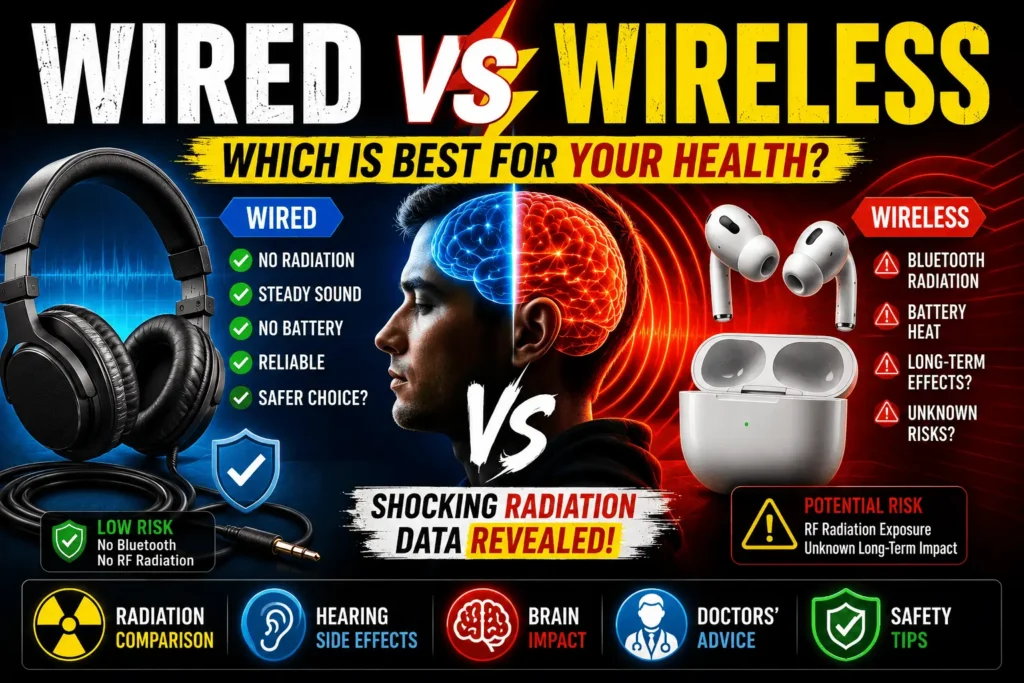
- Understanding the Difference Between Wired HEadphones and Wireless Headphones
- Radiation Comparison: Wired Headphones vs Wireless Headphones
- Radiation Exposure Chart
- What Doctors and Health Organizations Say
- Hearing Loss: The Biggest Proven Danger
- How Headphones Damage Hearing
- Which Type Is Worse for Hearing?
- Doctors Recommend the 60/60 Rule
- Potential Side Effects of Wireless Headphones
- Potential Side Effects of Wired Headphones
- Bluetooth vs Wired Headphones: Health Comparison Table
- What Neuroscientists and Researchers Say
- Are AirPods and Bluetooth Earbuds Dangerous?
- Which Is Better for Mental Focus and Sleep?
- The Safest Way to Use Headphones
- Wired vs Wireless Headphones: Which Is Best for Your Health?
- Final Verdict
In today’s digital world, headphones have become part of daily life. People use wired headphones or wireless ones while working, exercising, gaming, studying, traveling, and even sleeping. However, as wireless earbuds and Bluetooth headphones dominate the market, an important health question continues to grow:
Are wireless headphones safer than wired headphones, or do wired headphones remain the healthier option?
Many users worry about Bluetooth radiation, brain exposure, hearing damage, and long-term side effects. Meanwhile, doctors and researchers continue studying how prolonged headphone use affects hearing, sleep, concentration, and overall health.
Therefore, this article provides a detailed, evidence-based comparison between wired and wireless headphones, including radiation data, hearing risks, medical opinions, and practical safety tips to help you make the healthiest choice.
Understanding the Difference Between Wired HEadphones and Wireless Headphones
Before comparing health effects, it is important to understand how both technologies work.
Wired Headphones
Wired headphones transmit audio signals through physical cables connected directly to devices like phones, laptops, or music players. Consequently, they do not require Bluetooth or Wi-Fi signals.
Because of this, wired headphones produce almost no radiofrequency (RF) radiation near the head.
Wireless Headphones
Wireless headphones use Bluetooth technology to transmit audio signals wirelessly. Therefore, they continuously emit low-level radiofrequency electromagnetic fields (RF-EMF).
Bluetooth devices generally operate in the 2.4 GHz frequency range (see WHO guidelines), which is a type of non-ionizing radiation.
Although this radiation is significantly weaker than X-rays or UV rays, concerns remain regarding long-term exposure because the devices sit directly inside or near the ears for extended periods.
Radiation Comparison: Wired Headphones vs Wireless Headphones
One of the biggest health concerns involves radiation exposure.
Wireless Headphones Radiation Levels
Bluetooth headphones emit low-power RF radiation, typically around:
- 1 mW to 100 mW.
- Depending on device type and signal strength.
In comparison:
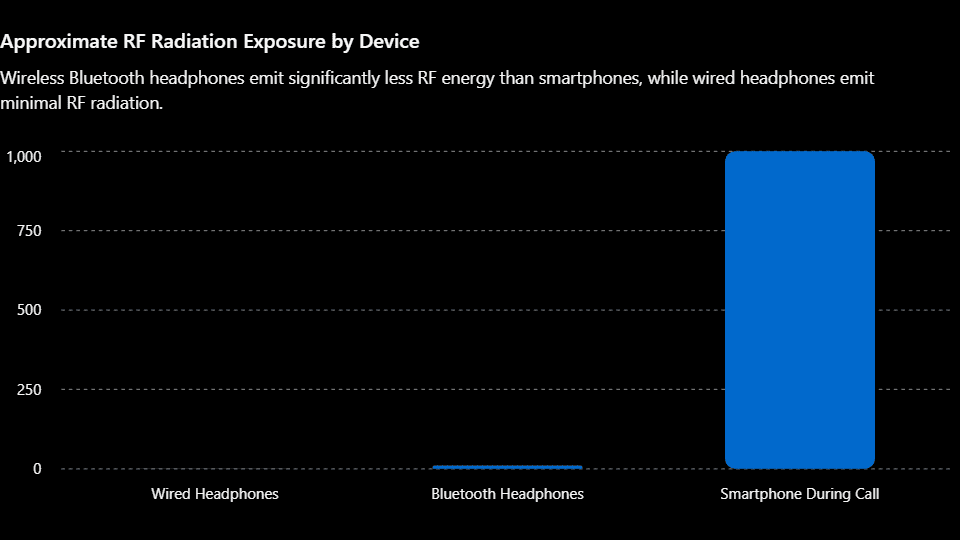
- Smartphones may emit up to 1000 mW (1 watt) during active communication.
Research shows Bluetooth devices generally emit far less radiation than mobile phones.
However, unlike phones, wireless earbuds remain positioned directly inside the ear canal for hours daily.
Wired Headphones Radiation Levels
Traditional wired headphones:
- Do not use Bluetooth transmission
- Produce negligible RF radiation near the head
- Reduce direct wireless exposure substantially
However, some researchers note that headphone wires can conduct small electromagnetic fields from connected devices, although these levels remain extremely low compared to Bluetooth transmission.
Radiation Exposure Chart
Approximate RF Radiation Exposure by Device
Wireless Bluetooth headphones emit significantly less RF energy (next to zero) than smartphones, while wired headphones emit minimal RF radiation. The values provided on the left are in mW (milliwatt).
What Doctors and Health Organizations Say
The debate about Bluetooth safety remains ongoing. Nevertheless, most major health organizations state that current evidence does not conclusively prove serious harm from Bluetooth headphones.
According to the World Health Organization, radiofrequency electromagnetic fields from wireless technologies are classified as “possibly carcinogenic” (Group 2B). However, WHO also states that no clear adverse health effects from low-level RF exposure have been conclusively established.
Similarly, the National Institute of Environmental Health Sciences explains that Bluetooth devices emit non-ionizing radiation, which differs substantially from dangerous ionizing radiation like X-rays.
Meanwhile, doctors consistently emphasize that the biggest proven health risk from headphones is not radiation — it is hearing damage caused by loud volume and prolonged usage.
Hearing Loss: The Biggest Proven Danger
Although radiation concerns attract headlines, excessive sound exposure causes far more immediate and scientifically proven harm.
How Headphones Damage Hearing
Loud audio damages tiny sensory hair cells inside the cochlea of the inner ear. Unfortunately, once these cells are damaged, they do not regenerate.

As a result, long-term headphone overuse can lead to:
- Permanent hearing loss
- Tinnitus (ringing ears)
- Ear fatigue
- Sound sensitivity
Which Type Is Worse for Hearing?
Interestingly, both wired and wireless headphones can damage hearing if volume remains too high.
However, earbuds — especially wireless in-ear models — may encourage louder listening because:
- They sit deeper inside the ear canal
- Users wear them longer
- Environmental noise causes people to increase volume
ENT surgeons increasingly report rising hearing issues among younger adults linked to prolonged earbud use.
Doctors Recommend the 60/60 Rule
Many hearing specialists recommend:
- Keeping volume below 60%
- Limiting listening sessions to 60 minutes continuously
This guideline significantly reduces hearing strain and long-term ear damage.
Potential Side Effects of Wireless Headphones
Although evidence remains inconclusive, some users report symptoms associated with prolonged wireless headphone usage.
These include:
- Headaches
- Ear warmth
- Sleep disturbances
- Ear discomfort
- Concentration issues
- Mental fatigue
However, researchers have not definitively proven Bluetooth radiation as the direct cause of these symptoms.
Still, scientists continue studying long-term low-level RF exposure because wireless technology usage keeps increasing globally.
Potential Side Effects of Wired Headphones
Wired headphones generally reduce RF exposure, yet they also have disadvantages.
Possible issues include:
- Ear strain from excessive volume
- Cable-related accidents
- Neck discomfort from long use
- Hygiene-related ear infections
Therefore, wired headphones are not automatically risk-free.
Bluetooth vs Wired Headphones: Health Comparison Table
| Health Factor | Wired Headphones | Wireless Headphones |
|---|---|---|
| RF Radiation Exposure | Very low | Low but continuous |
| Hearing Damage Risk | Moderate if loud | Moderate to high if loud |
| Convenience | Lower | Higher |
| Battery Heat Exposure | None | Present |
| Long-Term EMF Concern | Minimal | Under ongoing research |
| Sleep Disruption Potential | Low | Possibly higher for some users |
| Recommended for Lowest Radiation | Yes | No |
What Neuroscientists and Researchers Say
Some researchers and neuroscientists prefer reducing unnecessary wireless exposure as a precaution.
For example, discussions involving Andrew Huberman have increased public interest in limiting Bluetooth exposure near the brain.
However, many experts also caution against fear-based misinformation because:
- Bluetooth radiation remains extremely low
- Scientific evidence remains inconclusive
- Everyday smartphone exposure often exceeds headphone exposure
Therefore, moderation and balanced use remain the most reasonable approach.
Are AirPods and Bluetooth Earbuds Dangerous?
Currently, no major medical organization states that Bluetooth earbuds directly cause cancer or severe neurological disease.
According to multiple health experts:
- Bluetooth emits non-ionizing radiation
- Exposure levels remain below international safety limits
- Evidence linking Bluetooth to cancer remains weak and inconclusive
Nevertheless, researchers continue monitoring long-term exposure trends because wireless device use has increased dramatically over the last decade.
Which Is Better for Mental Focus and Sleep?
Interestingly, some users report:
- Better focus using wired headphones
- Reduced headaches
- Less ear fatigue
Although strong scientific evidence remains limited, minimizing constant wireless exposure may psychologically improve comfort for certain individuals.
Furthermore, excessive headphone use — especially late at night — can negatively affect sleep regardless of connection type.
Blue light exposure, stimulating audio, and prolonged screen time often contribute more to sleep problems than headphone radiation itself.
The Safest Way to Use Headphones
Rather than focusing only on wired versus wireless, health experts recommend safer listening habits overall.
1. Lower the Volume
Always keep volume at safe levels.
2. Limit Listening Duration
Take breaks every 60–90 minutes.
3. Prefer Over-Ear Models
Over-ear headphones reduce direct ear canal pressure.
4. Avoid Sleeping With Earbuds
Continuous overnight use may affect hearing and ear hygiene.
5. Use Wired Headphones for Long Sessions
If you use headphones for many hours daily, wired options reduce RF exposure.
6. Keep Bluetooth Devices Away When Not Needed
Turning off Bluetooth minimizes unnecessary RF exposure.
Wired vs Wireless Headphones: Which Is Best for Your Health?
If your primary concern is:
- Lowest radiation exposure
- Maximum precaution
- Reduced RF exposure near the brain
then wired headphones remain the healthier option overall.
However, if:
- You use moderate volume
- Take regular breaks
- Avoid excessive daily usage
then wireless headphones are generally considered safe according to current scientific evidence.
Importantly, the greatest proven health risk from both types remains hearing damage caused by loud listening habits — not radiation.
Therefore, healthy listening behavior matters far more than whether your headphones use wires or Bluetooth.
Final Verdict
The debate between wired and wireless headphones continues because long-term research on wireless exposure remains incomplete. Nevertheless, current evidence suggests that Bluetooth radiation levels remain relatively low and fall within international safety standards.
At the same time, wired headphones provide an advantage for people who prefer minimizing electromagnetic exposure entirely.
Ultimately:
- Wired headphones offer lower RF exposure
- Wireless headphones offer greater convenience
- Both can damage hearing if volume stays too high
Therefore, the healthiest approach involves:
- Lower volume
- Limited listening time
- Regular hearing breaks
- Balanced technology usage
In the end, your listening habits matter more than the technology itself. Protecting your hearing today may save your health tomorrow.
This article has been made with the help of AI for better SEO but the research and inputs have been provided by me. Source1, Source2, Source3, Source4.
You may also like to read other health related articles here also authored by me :
Current Situation of Hantavirus Incident on MV Hondius
Royal Jelly: Nature’s Most Potent “Wonder Food”