- 🚨 What Is the CMS Hospice Enrollment Moratorium?
- 🩺 Why CMS Imposed the Moratorium
- 📈 Why Hospice Fraud Became a National Issue
- 🔍 Why California Became the Center of Attention
- ⚖️ Supporters Say the Crackdown Was Necessary
- 🏥 Critics Warn About Access-to-Care Problems
- 💬 Healthcare Community Reactions Continue to Grow
- 🧬 How the Moratorium Could Affect Patients
- 📊 What This Means for Hospice Providers
- 🔎 Existing Providers Face Increased Scrutiny
- 🏛️ The Political Impact of the CMS Crackdown
- 🌎 Why This Story Matters Nationally
- ❤️ The Human Side of the Debate
- 🔮 What Happens Next?
- Final Thoughts
- FAQs About the CMS Hospice Enrollment Moratorium
The healthcare industry faced a major shake-up this week after the Centers for Medicare & Medicaid Services announced a nationwide moratorium on new Medicare enrollments for hospice and home health providers. The decision immediately sparked debate across the healthcare sector because the move could reshape how hospice care operates (CMS Hospice) across the United States for months — or possibly longer.
While federal officials say the moratorium targets widespread fraud and abuse, critics argue that the policy could unintentionally reduce access to end-of-life care, especially in rural and underserved communities.
Consequently, providers, healthcare executives, patients, and policymakers are now watching closely to see how this aggressive federal crackdown unfolds.
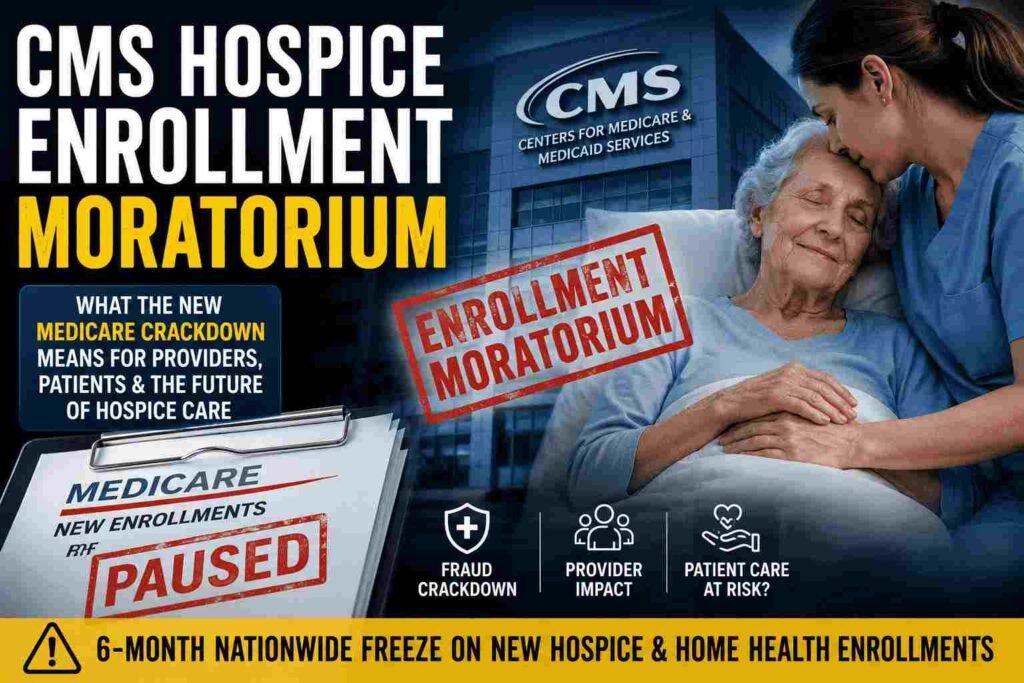
🚨 What Is the CMS Hospice Enrollment Moratorium?
On May 13, 2026, the Centers for Medicare & Medicaid Services announced a six-month nationwide freeze on new Medicare enrollments for:
- Hospice agencies
- Home health agencies
The policy prevents new providers from joining the Medicare reimbursement system during the moratorium period. However, existing hospice providers can continue operating normally.
According to CMS, the moratorium forms part of a broader federal anti-fraud initiative coordinated with Vice President JD Vance’s Anti-Fraud Task Force.
🩺 Why CMS Imposed the Moratorium
Federal officials claim that fraudulent hospice and home health operations have increased significantly in recent years.
According to CMS Administrator Mehmet Oz, some providers exploited vulnerable Medicare patients while improperly billing taxpayers for unnecessary or fraudulent services.
Additionally, CMS stated that scammers frequently create new companies after regulators shut down previous operations. Therefore, officials believe the temporary enrollment freeze will stop bad actors from rapidly re-entering the Medicare system under different business names.
The agency also plans to:
- Expand fraud investigations
- Use advanced analytics to detect suspicious billing
- Increase provider oversight
- Accelerate removal of fraudulent agencies
- Tighten ownership screening processes
📈 Why Hospice Fraud Became a National Issue
Hospice care has grown dramatically over the past decade. As America’s population ages, more families rely on hospice services for end-of-life care.
According to recent Medicare data:
- Around 1.8 million Medicare beneficiaries received hospice care in 2024
- Medicare hospice spending reached approximately $28.3 billion
Consequently, the rapid growth in hospice spending also attracted fraud schemes involving:
- Fake patient enrollments
- Unnecessary services
- Identity theft
- Billing for patients who did not qualify for hospice care
- Phantom healthcare operations
Federal investigators increasingly focused on states such as:
- California
- Texas
- Nevada
- Arizona
- Georgia
- Ohio
because regulators identified unusually high rates of suspicious hospice activity in those areas.
🔍 Why California Became the Center of Attention
California emerged as one of the largest hotspots for alleged hospice fraud in the country.
Recent investigations uncovered:
- Suspicious billing networks
- Questionable ownership structures
- Dozens of linked hospice facilities
- Millions of dollars in allegedly fraudulent Medicare claims
Federal officials recently suspended payments to hundreds of hospice agencies and home health providers in Los Angeles alone. CMS said the suspended funds already exceeded $70 million.
Additionally, lawmakers criticized California regulators for failing to implement stronger oversight measures earlier.
As a result, the hospice fraud issue quickly escalated into a national political debate.
⚖️ Supporters Say the Crackdown Was Necessary
Many healthcare fraud investigators and compliance experts support the CMS decision.
Supporters argue that:
- Fraudulent providers exploit dying patients
- Medicare loses billions through improper billing
- Weak oversight allowed unethical operators to flourish
- Strong intervention became unavoidable
Moreover, some experts believe a nationwide moratorium prevents scammers from simply relocating operations to different states.
CMS officials also described the move as one of the largest anti-fraud efforts in agency history.
🏥 Critics Warn About Access-to-Care Problems
Despite fraud concerns, many healthcare organizations strongly criticized the nationwide freeze.
The American Hospital Association warned that blanket restrictions could worsen healthcare access in rural and underserved communities.
Critics argue that:
- Legitimate providers now face unnecessary barriers
- Growing patient demand may exceed current hospice capacity
- Rural areas already struggle with provider shortages
- Existing providers could become overwhelmed
Additionally, several healthcare leaders questioned whether the moratorium truly addresses fraud already occurring inside established organizations.
Consequently, the healthcare industry remains sharply divided over the policy.
💬 Healthcare Community Reactions Continue to Grow
The announcement immediately triggered strong reactions across medical communities, legal experts, and online healthcare forums.
Some clinicians praised the federal government for finally confronting widespread abuse within hospice care.
However, others argued that the moratorium:
- Punishes legitimate providers
- Slows innovation
- Reduces competition
- Creates uncertainty for new hospice startups
On medical discussion forums and Reddit healthcare communities, many commenters expressed concern that the freeze could unintentionally strain patient care systems.
At the same time, compliance experts predict much tighter regulatory oversight moving forward.
🧬 How the Moratorium Could Affect Patients
For now, existing hospice agencies can continue serving Medicare patients without interruption.
Therefore, most experts believe patients will not experience immediate disruptions.
Nevertheless, longer-term concerns remain.
⚠️ Potential future risks include:
- Longer wait times
- Reduced hospice availability in rural regions
- Fewer provider choices
- Slower expansion into underserved communities
Additionally, if CMS extends the moratorium beyond six months, healthcare access concerns could intensify significantly.
📊 What This Means for Hospice Providers
The moratorium creates major operational challenges for organizations planning to enter the Medicare hospice market.
🚫 New Providers Face Immediate Delays
New hospice agencies now cannot enroll in Medicare reimbursement programs during the freeze period.
Consequently, startup providers may:
- Delay business launches
- Lose investment funding
- Pause expansion plans
- Face staffing uncertainty
🔎 Existing Providers Face Increased Scrutiny
Meanwhile, existing providers should expect:
- More audits
- Expanded site visits
- Enhanced ownership verification
- Greater billing oversight
- Increased compliance demands
Healthcare attorneys already advise providers to strengthen documentation and internal fraud-prevention systems immediately.
🏛️ The Political Impact of the CMS Crackdown
The hospice moratorium also reflects broader political efforts to reduce fraud, waste, and abuse in federal healthcare spending.
The Trump administration increasingly emphasized aggressive anti-fraud enforcement across:
- Medicare
- Medicaid
- Durable medical equipment suppliers
- Home health services
Earlier this year, CMS also paused new enrollments for certain medical equipment suppliers.
Consequently, healthcare experts believe additional enforcement actions may follow in other high-risk sectors.
🌎 Why This Story Matters Nationally
This issue extends far beyond healthcare administration.
The hospice enrollment moratorium affects:
- Aging Americans
- Families navigating end-of-life care
- Healthcare entrepreneurs
- Investors
- Rural healthcare systems
- Medicare spending policies
Additionally, the policy highlights growing national concerns regarding:
- Healthcare fraud
- Oversight failures
- Private equity involvement in healthcare
- Rising Medicare costs
Because America’s senior population continues growing rapidly, hospice care will likely remain a major policy focus for years ahead.
❤️ The Human Side of the Debate
Behind every policy discussion lies a deeply personal reality.
Hospice care supports patients and families during some of the most emotionally difficult moments of life. Therefore, concerns about fraud feel especially troubling because vulnerable patients often depend entirely on these services.
At the same time, legitimate hospice providers fear that broad restrictions could make compassionate care harder to access.
Consequently, federal regulators now face a difficult balancing act:
- stopping fraud aggressively
while also - preserving patient access to quality care
🔮 What Happens Next?
The current moratorium lasts six months. However, healthcare analysts believe CMS could:
- Extend the freeze
- Introduce stricter enrollment rules
- Expand fraud monitoring technology
- Increase provider screening permanently
Meanwhile, industry organizations will likely continue lobbying for more targeted enforcement rather than nationwide restrictions.
Therefore, the next several months could significantly reshape the future of hospice regulation in America.
Final Thoughts
The CMS hospice enrollment moratorium marks one of the most aggressive Medicare anti-fraud actions in recent years.
Federal officials insist the crackdown protects taxpayers and vulnerable patients from exploitation. However, critics worry the policy may also restrict access to essential end-of-life care.
As investigations continue and political pressure grows, the healthcare industry now faces a critical question:
Can regulators eliminate fraud without harming legitimate hospice care providers and the patients who depend on them?
The answer could shape the future of Medicare hospice services for years to come.
FAQs About the CMS Hospice Enrollment Moratorium
What is the CMS hospice enrollment moratorium?
CMS temporarily halted new Medicare enrollments for hospice and home health providers nationwide for six months.
Why did CMS impose the moratorium?
Federal officials cited widespread fraud, waste, and abuse in the hospice and home health sectors.
Will existing hospice providers shut down?
No. Existing Medicare-certified providers can continue operating normally.
Does the moratorium affect patients currently receiving hospice care?
Currently, patients should not experience immediate disruptions because existing providers remain active.
How long will the moratorium last?
CMS announced an initial six-month freeze beginning May 13, 2026.
Which states faced the highest fraud concerns?
Officials identified elevated fraud risks in states including California, Texas, Nevada, Arizona, Georgia, and Ohio.
Could CMS extend the moratorium?
Yes. Healthcare analysts believe CMS may extend or modify the freeze depending on future fraud investigations.
What are critics most concerned about?
Critics worry the moratorium could reduce patient access to hospice care, especially in rural and underserved communities.
This article has been made with the help of AI for better SEO but the research and inputs have been provided by me. Sources cited below.
- CMS Official Press Release
- Reuters – CMS Medicare Enrollment Freeze Coverage
- American Hospital Association
- Hospice News
- National Hospice and Palliative Care Organization
- Centers for Medicare & Medicaid Services
You may also like to read other health related articles here also authored by me :
Breast Cancer Symptoms Women Ignore: Early Warning Signs
GLP-1 Lifestyle and Longevity Hub: 2026 Guide
Pancreatic Cancer: Early Signs, Causes, Treatment, & Prevention