- 🏥 America Pays More Than Everyone Else
- 💳 Health Insurance Turned Healthcare Into Bureaucracy
- 🚫 Insurance Denials Became a National Frustration
- 📝 Prior Authorization Delays Critical Care
- 🏢 Insurance Consolidation Reduced Competition
- 🔄 Insurers Started Buying Doctors
- 👨⚕️ America Also Created a Doctor Shortage
- 🏥 Hospital Consolidation Increased Prices Too
- 💼 Private Equity Entered Healthcare
- 💊 Americans Pay the Highest Drug Prices in the World
- 🧪 Pharma’s Ethical Problems Deepened Distrust
- 📉 Medical Debt Became Normalized
- 🚨 The System Works Best for the Wealthy
- ⚖️ The Core Problem: Incentives
- 🧭 Final Thoughts
- ❓FAQs About How Broken is US Healthcare
On December 4th, 2024, early in the morning in Midtown Manhattan, UnitedHealthcare CEO Brian Thompson was shot and killed. The words allegedly written on the bullets — “deny, depose, defend” — immediately ignited national debate. Instead of overwhelming sympathy for the victim, millions of Americans began discussing something much deeper: the state of US healthcare itself.
That reaction shocked the media. However, for many Americans, the frustration had been building for decades.
Evidently, the United States spends more money on healthcare than any nation on Earth — by a massive margin. Yet Americans visit doctors less often than citizens in other wealthy countries, experience shorter life expectancy, face enormous medical debt, and regularly delay treatment because of cost.
So people naturally ask:
If America spends nearly $5 trillion annually on healthcare, why does the system still feel broken?
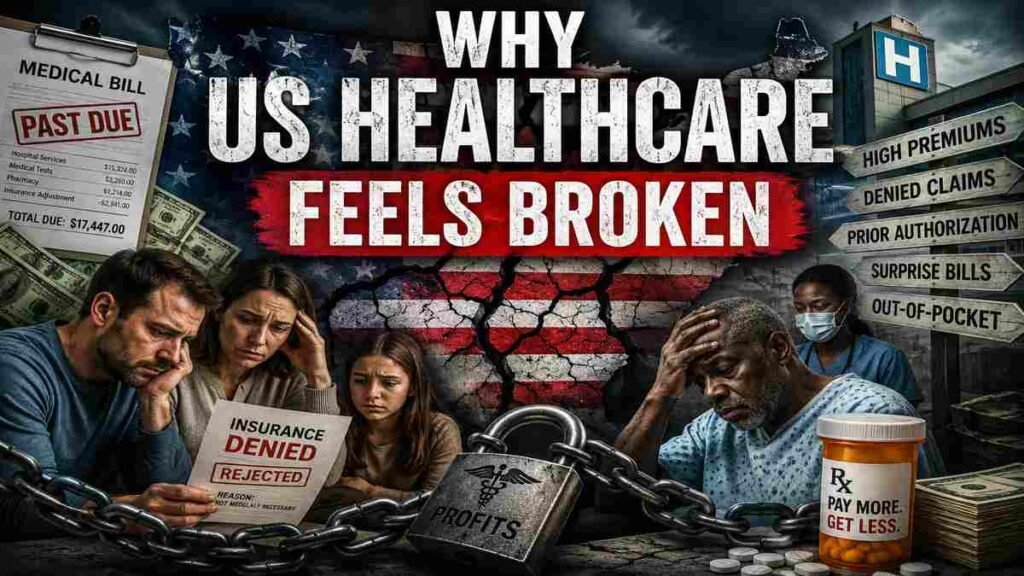
The answer lies in a dangerous mix of insurance complexity, corporate consolidation, administrative overload, drug pricing, and profit-driven incentives that often work against patients instead of helping them.
At this point, this is not a story about one bad company. Instead, it is about an entire system that increasingly feels disconnected from the people it is supposed to serve. We must ponder “How Broken is US Healthcare?”
🏥 America Pays More Than Everyone Else
The US healthcare system consumes nearly 18% of America’s GDP, totaling close to $5 trillion annually.
No other developed country spends remotely close to that amount.
Yet despite the staggering cost:
- Americans see doctors less frequently than people in comparable nations
- US life expectancy remains lower than other wealthy countries
- Healthcare outcomes rank poorly compared to peer nations
- Millions avoid medical care because they cannot afford it
Even financially, experts estimate the US could potentially save trillions by improving efficiency and reducing waste.
So where does all the money actually go?
To understand that, you have to examine the three major pillars of American healthcare:
- Insurance companies
- Healthcare providers
- Pharmaceutical corporations
And unfortunately, every layer contains serious structural problems.
💳 Health Insurance Turned Healthcare Into Bureaucracy
Roughly 92% of Americans have some form of health insurance through:
- employers
- government programs
- individual marketplace plans
Unlike many universal healthcare systems, Americans navigate dozens of competing insurance providers, each operating differently.
At first glance, choice sounds beneficial. However, that “choice” created extraordinary complexity.
Every insurance company may have:
- different billing codes
- different prior authorization rules
- different doctor networks
- different pharmacy systems
- different reimbursement policies
- different approval standards
Hence, hospitals and clinics now spend massive amounts of money managing paperwork instead of treating patients.
According to hospital industry estimates, administrative work accounts for nearly 40% of hospital expenses.
Not surgery.
Not medicine.
Nor patient care.
Administration.
Consequently, doctors and nurses increasingly work inside a billing machine instead of a healthcare system.
🚫 Insurance Denials Became a National Frustration
One of the biggest reasons Americans feel angry toward insurers involves claim denials.
Health insurance companies deny enormous numbers of claims every year. Some companies reject claims at shockingly high rates.
That means doctors recommending treatment often face resistance from insurance corporations before patients can receive care.
For patients, the consequences become brutal:
- delay treatment
- pay out of pocket
- skip care entirely
- accumulate debt
Meanwhile, healthcare-related debt contributes heavily to bankruptcies across the country.
Insurance companies defend denials by arguing they prevent unnecessary procedures and control costs. To some extent, that argument has merit.
However, denial rates continue increasing.
At the same time, appeals remain extremely difficult.
Most patients never challenge rejected claims because appeals require:
- time
- paperwork
- persistence
- medical knowledge
- emotional energy
Ironically, large numbers of appealed denials later get overturned anyway.
That reality fuels public distrust because many Americans believe insurers intentionally reject claims knowing most patients will simply give up.
📝 Prior Authorization Delays Critical Care
Prior authorization became another major source of frustration.
Under this system:
- a doctor recommends treatment
- the insurer must approve it first
Again, insurers argue this process prevents unnecessary spending.
However, doctors across specialties increasingly report serious harm caused by delays.
Some physicians describe situations where prior authorization contributed to:
- emergency hospitalization
- worsening illness
- permanent disability
Radiation oncologists, for example, have publicly discussed patients suffering severe complications because approval processes delayed treatment.
Doctors also complain that insurer “peer reviewers” frequently lack expertise in the exact specialty being evaluated.
As a result, medical decisions increasingly feel influenced by corporate process rather than clinical judgment.
🏢 Insurance Consolidation Reduced Competition
Meanwhile, the insurance industry consolidated aggressively over time.
Today, many regional markets are dominated by only a handful of giant corporations.
Supporters once claimed consolidation would:
- lower administrative costs
- improve negotiating power
- reduce premiums
Instead, premiums kept rising.
Research examining major insurance mergers repeatedly found similar patterns:
- less competition
- higher prices
- greater corporate leverage
Additionally, new insurers struggle entering the market because healthcare requires:
- enormous scale
- regulatory compliance
- provider contracts
- infrastructure
Therefore, dominant companies maintain tremendous power with limited competition.
🔄 Insurers Started Buying Doctors
Insurance corporations did not stop at selling policies.
Increasingly, they began buying:
- physician groups
- healthcare networks
- clinics
- pharmacies
Some insurers now directly employ tens of thousands of physicians.
At first, vertical integration appeared efficient. However, critics argue it concentrates even more power inside a small number of corporations.
The concern becomes obvious:
- insurers control payment
- insurers control networks
- insurers increasingly influence treatment decisions too
Consequently, patients worry financial incentives may outweigh medical priorities.
👨⚕️ America Also Created a Doctor Shortage
Another major problem involves physician supply.
Compared with many developed nations, the United States has fewer doctors per capita.
One reason traces back decades.
Medical organizations once feared America would produce “too many doctors.” Therefore:
- residency positions were restricted
- federal training funding stayed limited
- physician supply growth slowed
Meanwhile, the population continued growing rapidly.
The result?
- fewer doctors
- longer wait times
- higher physician salaries
- more expensive healthcare overall
Healthcare demand exploded while supply stayed artificially constrained.
🏥 Hospital Consolidation Increased Prices Too
Hospitals consolidated aggressively just like insurers.
Over the past two decades:
- hospitals merged
- corporate systems expanded
- independent practices disappeared
Today, most doctors work for large organizations instead of independent clinics.
Supporters promised:
- efficiency
- lower costs
- streamlined care
However, many studies found prices rose significantly after consolidation.
Once hospital systems dominate a region, patients lose negotiating power because they cannot realistically “shop around” during emergencies.
As a result, healthcare systems gain enormous pricing leverage.
💼 Private Equity Entered Healthcare
Private equity firms saw healthcare as a massive investment opportunity.
They purchased:
- anesthesiology groups
- dermatology practices
- nursing homes
- specialty clinics
From a business standpoint, healthcare looks attractive because demand remains relatively stable.
However, critics argue private equity ownership often prioritizes:
- higher billing
- aggressive cost cutting
- operational efficiency over patient care
Some studies linked private equity ownership with:
- rising prices
- worsening patient outcomes
- higher complication rates
One especially controversial example involved anesthesia groups allegedly charging dramatically higher reimbursement rates after dominating local markets.
In healthcare, market power directly translates into pricing power.
💊 Americans Pay the Highest Drug Prices in the World
Prescription drugs represent another enormous problem.
The United States accounts for roughly 44% of the global pharmaceutical market.
Yet Americans frequently pay dramatically more for the exact same medications sold elsewhere.
Some cancer drugs cost tens of thousands of dollars more annually in America than in comparable countries.
Even generic medications vary wildly in price depending on:
- location
- insurer
- pharmacy
- plan structure
Why does this happen?
Unlike many developed nations, the US government historically avoided directly negotiating drug prices broadly across the healthcare system.
Consequently, pharmaceutical companies retain extraordinary pricing power.
🧪 Pharma’s Ethical Problems Deepened Distrust
Drug pricing alone already frustrates Americans. However, ethical concerns made trust even worse.
Pharmaceutical companies spend billions on:
- consulting relationships
- speaking fees
- sponsored research
- physician marketing
Critics argue these financial relationships blur the line between medicine and sales.
Major scandals — especially the opioid crisis — intensified public anger.
Many Americans now question:
“Are prescriptions always based purely on medical need?”
That uncertainty damages trust not only in pharma companies, but sometimes in healthcare itself.
📉 Medical Debt Became Normalized
Perhaps the clearest sign of systemic failure is medical debt.
Even insured Americans routinely face:
- deductibles
- coinsurance
- surprise bills
- uncovered services
A single emergency room visit can create thousands of dollars in charges within hours.
Consequently:
- families drain savings
- patients delay treatment
- stress skyrockets
- financial insecurity worsens
Healthcare should help people recover physically.
Instead, for many Americans, illness also creates financial trauma.
🚨 The System Works Best for the Wealthy
Ironically, the US healthcare system also contains some of the world’s best:
- hospitals
- specialists
- technologies
- treatments
If you are wealthy or exceptionally well-insured, American healthcare can feel extraordinary.
The problem is accessibility.
The system resembles a luxury supercar:
- incredibly powerful
- incredibly advanced
- but financially unreachable for many people
That contradiction sits at the center of America’s healthcare debate.
⚖️ The Core Problem: Incentives
At its heart, the system suffers from deeply misaligned incentives.
Insurance companies maximize profit by:
- limiting payouts
- denying claims
- reducing approvals
Hospitals maximize profit through:
- consolidation
- higher pricing
- market dominance
Pharmaceutical companies maximize profit through:
- patent protection
- pricing leverage
- aggressive marketing
Meanwhile, patients simply want affordable, accessible care.
That disconnect explains why public frustration continues growing.
🧭 Final Thoughts
The American healthcare system did not become dysfunctional overnight. Decades of consolidation, administrative complexity, political compromise, and profit-driven incentives slowly transformed healthcare into something millions of Americans barely recognize anymore.
To be clear, the United States still produces remarkable medical innovation. Many American doctors and hospitals remain among the best in the world.
However, excellent medicine alone does not guarantee a healthy system.
When families avoid treatment because of cost, when insurers delay critical care through paperwork, and when medical debt becomes routine, people naturally lose trust.
That is why US healthcare feels broken.
Not because America lacks medical talent.
But because the system surrounding that talent increasingly prioritizes revenue, bureaucracy, and corporate power over patient well-being.
❓FAQs About How Broken is US Healthcare
Why is US healthcare so expensive?
Administrative complexity, insurance overhead, hospital consolidation, physician shortages, and high drug prices all contribute heavily to rising costs.
Why do insurance companies deny medical claims?
Insurers argue denials control unnecessary spending, although critics believe excessive denials increase corporate profits.
Why are prescription drugs more expensive in America?
The US historically allowed pharmaceutical companies greater pricing power compared to countries that negotiate drug prices nationally.
Why do Americans fear medical debt?
Even insured patients often face deductibles, coinsurance, surprise billing, and uncovered medical expenses.
Does the US still have good healthcare?
Yes. The US offers some of the world’s best hospitals, specialists, and medical technologies. However, affordability and accessibility remain major problems.
Why do doctors dislike prior authorization?
Prior authorization often delays treatment and forces physicians to spend large amounts of time on insurance paperwork.
Did hospital consolidation lower healthcare costs?
In many cases, consolidation increased prices because dominant hospital systems gained greater market power.
Is private healthcare always bad?
Not necessarily. Private healthcare can drive innovation and efficiency. However, without strong safeguards, profit incentives may conflict with patient care.
Authoritative Source Links
- Commonwealth Fund – US Healthcare System Rankings
- Kaiser Family Foundation (KFF) – Healthcare Costs & Medical Debt
- Centers for Medicare & Medicaid Services (CMS) – National Health Expenditure Data
- OECD Health Statistics – International Healthcare Comparisons
- American Hospital Association – Administrative Costs in Healthcare
- JAMA Network – Private Equity and Healthcare Research
- National Institutes of Health (NIH) – Healthcare Administrative Costs
You may also like to read other health related articles here also authored by me :
Remove Cellphone Addiction in Your Kids: Proven Strategies
Your Self-Talk Is Killing Your Performance: Special Forces Mindset
7 Toxic Kidney Warning Signs You Should Never Ignore