- 🚑 Fastest Ways Canadians Reduce Hospital Wait Times
- 🍁 Why Canadian Hospital Wait Times Became So Severe
- 🍁 Province-by-Province Workarounds & Alternatives
- ⚠️ When You SHOULD Go to the Emergency Room
- 🌎 Are Private Healthcare Alternatives Growing in Canada?
- 🧭 Final Thoughts
- ❓FAQs About Canadian Hospital Wait Times
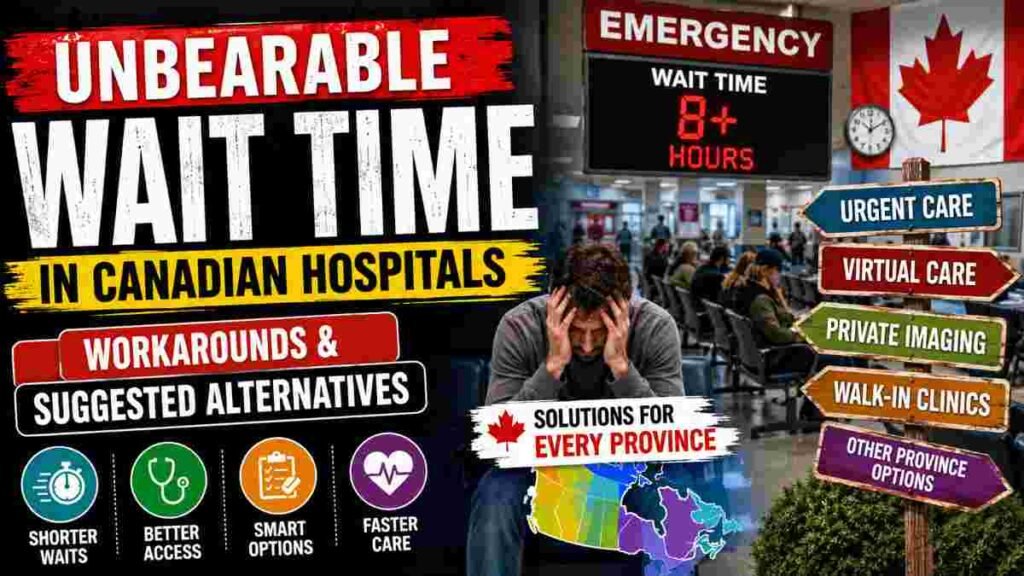
If you live in Canada, you already know the frustration: endless emergency room lines, delayed surgeries, specialist appointments booked months away, and family doctors stretched beyond capacity. While Canada offers universal healthcare, many Canadians still struggle to access timely treatment. Canadian Hospital Wait Times are one of the longest in the world.
The good news is this: you do have options.
Depending on your province, you can often reduce hospital wait times by using urgent care centers, virtual healthcare apps, nurse practitioner clinics, private diagnostic services, cross-provincial referrals, after-hours clinics, and specialized fast-track programs. In some situations, traveling to another province or using private imaging services can save weeks — or even months.
This guide breaks down:
- Why Canadian hospital wait times became so severe
- The best workarounds available nationwide
- Province-specific alternatives
- Smart strategies that Canadians actually use to get faster care
Let’s start with the most practical solutions first.
🚑 Fastest Ways Canadians Reduce Hospital Wait Times
Before diving province-by-province, these workarounds help almost everywhere in Canada.
📱 Use Virtual Healthcare First
Many Canadians waste hours sitting in ER waiting rooms for non-emergencies. Instead, virtual care apps can quickly connect you with doctors for:
- Prescription renewals
- Minor infections
- Referrals
- Lab requests
- Mental health support
Popular services include:
- Maple
- TELUS Health MyCare
- Rocket Doctor
- Tia Health
Additionally, some provincial health plans partially cover virtual appointments.
🏥 Visit Urgent Care Instead of Emergency Rooms
Emergency departments prioritize life-threatening conditions. Therefore, less severe cases often wait for many hours.
Urgent care centers handle:
- Minor fractures
- Cuts
- Infections
- Fever
- Moderate pain
- Minor breathing issues
Consequently, wait times usually stay far shorter than hospital ERs.
🩻 Pay Privately for Diagnostic Imaging
This workaround has become increasingly common.
In several provinces, patients wait months for:
- MRI scans
- CT scans
- Ultrasounds
However, private imaging clinics often provide appointments within days.
Although you pay out-of-pocket, faster imaging can accelerate:
- Specialist referrals
- Surgery approvals
- Cancer detection
- Treatment planning
For many Canadians, this trade-off feels worthwhile.
📍 Ask for Referrals Outside Your City
Many people do not realize specialists can sometimes refer patients to:
- Smaller cities
- Rural hospitals
- Less crowded regions
As a result, traveling a few hours may dramatically reduce waiting time.
🍁 Why Canadian Hospital Wait Times Became So Severe
Several factors contribute to today’s healthcare delays.
👩⚕️ Staffing Shortages
Canada faces shortages of:
- Nurses
- Family doctors
- Emergency physicians
- Specialists
Furthermore, burnout after the pandemic worsened staffing problems significantly.
📈 Aging Population
As Canada’s population ages, healthcare demand rises rapidly.
Older adults typically require:
- More surgeries
- Chronic disease management
- Frequent hospital visits
- Long-term care
Consequently, hospitals face overwhelming pressure.
🏛️ Limited Healthcare Capacity
Although Canada spends heavily on healthcare, hospital bed availability remains relatively limited compared to demand.
Additionally, administrative bottlenecks slow patient flow across the system.
🍁 Province-by-Province Workarounds & Alternatives
Now let’s explore practical alternatives across every Canadian province.
🏔️ British Columbia (BC)
Common Problems
- Long ER waits in Vancouver
- Delayed specialist access
- Family doctor shortages
Best Workarounds
📱 Use HealthLink BC (811) 🔗
Nurses can guide patients toward faster care options instead of crowded ERs.
🩺 Visit UPCC Clinics 🔗
Urgent and Primary Care Centres (UPCCs) help patients without family doctors.
🩻 Private MRI Clinics
Several private clinics offer faster imaging for a fee.
🌾 Alberta
Common Problems
- Overcrowded Calgary and Edmonton hospitals
- Specialist backlogs
Best Workarounds
🚶 Use Walk-In Clinics Aggressively 🔗
Alberta still has many accessible walk-in clinics compared to other provinces.
📲 Try Virtual Clinics 🔗
Virtual care remains widely available across Alberta.
🏥 Smaller Regional Hospitals
Patients often receive faster care outside Calgary and Edmonton.
🌲 Saskatchewan
Common Problems
- Rural access issues
- Surgery delays
Best Workarounds
🚗 Travel to Regional Centers 🔗
Smaller regional facilities sometimes process cases faster.
📞 Request Waitlist Transfers
Ask specialists whether shorter waitlists exist elsewhere in the province.
🌾 Manitoba
Common Problems
- Winnipeg ER overcrowding
- Long specialist delays
Best Workarounds
🩺 Minor Injury Clinics
Many non-emergency cases move faster through injury clinics than ERs.
📋 Use Cancellation Lists
Ask to join specialist cancellation lists for earlier appointments.
🍁 Ontario
Common Problems
- Family doctor shortages
- Massive GTA hospital congestion
- Diagnostic imaging delays
Best Workarounds
🏥 Visit Urgent Care Centers 🔗
Ontario has extensive urgent care infrastructure.
📱 Use Health811 🔗
Ontario’s nurse hotline often redirects patients toward faster options.
🩻 Private Imaging Clinics
Private MRIs and ultrasounds remain popular for reducing delays.
🚆 Seek Specialists Outside Toronto
Smaller Ontario cities often provide quicker appointments.
⚜️ Quebec
Common Problems
- Extremely long ER waits
- Limited family doctor access
Best Workarounds
📲 GAP System 🔗
Quebec’s Guichet d’Accès à la Première ligne helps unattached patients find care.
🏥 Super Clinics (GMFs) 🔗
Family Medicine Groups often provide faster access than hospitals.
💻 Telemedicine Services
Virtual medicine continues expanding rapidly in Quebec.
🌊 New Brunswick
Common Problems
- Rural healthcare shortages
- Long emergency waits
Best Workarounds
📞 eVisitNB 🔗
Virtual healthcare significantly reduces unnecessary ER visits.
🩺 Pharmacist Prescribing
Expanded pharmacist authority now handles some minor conditions faster.
🦞 Nova Scotia
Common Problems
- Severe family doctor shortages
- Emergency department overcrowding
Best Workarounds
📱 VirtualCareNS 🔗
Nova Scotia residents without family doctors can use virtual physician access.
🏥 Mobile Primary Care Clinics
Temporary clinics help reduce pressure on hospitals.
🌅 Prince Edward Island
Common Problems
- Limited specialist availability
- Small healthcare capacity
Best Workarounds
🚢 Cross-Province Referrals
Patients sometimes receive faster care in nearby provinces.
📋 Centralized Waitlists
Actively checking waitlist updates may secure earlier openings.
🐟 Newfoundland and Labrador
Common Problems
- Geographic access challenges
- Specialist shortages
Best Workarounds
💻 Telehealth Expansion 🔗
Virtual care helps remote communities access physicians faster.
✈️ Travel Assistance Programs
Certain medical travel support programs reduce barriers to regional care.
❄️ Northern Territories (Yukon, Northwest Territories, Nunavut)
Common Problems
- Remote access
- Limited specialists
- Transportation delays
Best Workarounds
🛩️ Medical Travel Programs 🔗
Territorial governments often support travel for specialized care.
📱 Telemedicine 🔗
Remote consultations significantly improve access in northern communities.
💡 Smart Strategies Canadians Rarely Use
📅 Call Early in the Morning
Appointment cancellations happen constantly. Therefore, calling clinics right after opening often helps.
📝 Ask to Be Waitlisted for Cancellations
Many specialists maintain cancellation lists but rarely advertise them.
This single tactic can cut months off waiting times.
🧠 Be Specific About Symptoms
Clearly describing worsening symptoms may accelerate triage priority.
However, always stay truthful and accurate.
👨⚕️ Use Pharmacists More Often
Canadian pharmacists increasingly help with:
- Minor infections
- Prescription renewals
- Vaccinations
- Chronic condition management
As a result, many patients avoid unnecessary hospital visits entirely.
⚠️ When You SHOULD Go to the Emergency Room
Despite long waits, never avoid the ER for:
- Chest pain
- Stroke symptoms
- Severe breathing difficulty
- Major trauma
- Heavy bleeding
- Sudden neurological symptoms
In these situations, immediate care matters far more than wait times.
🌎 Are Private Healthcare Alternatives Growing in Canada?
Yes — although Canada remains publicly funded, private alternatives continue expanding.
Growth areas include:
- Diagnostic imaging
- Virtual healthcare
- Executive health clinics
- Private physiotherapy
- Specialty consultations
Still, laws differ significantly between provinces.
🧭 Final Thoughts
Canadian healthcare still provides universal coverage, which remains incredibly valuable. Nevertheless, unbearable wait times continue frustrating millions of Canadians nationwide.
Thankfully, patients are not completely powerless.
Using urgent care centers, virtual medicine, private diagnostics, regional referrals, pharmacist services, and cancellation waitlists can dramatically improve healthcare access.
Most importantly, knowing your provincial alternatives often saves far more time than simply waiting passively for the system to move faster.
❓FAQs About Canadian Hospital Wait Times
Why are Canadian hospital wait times so long?
Staff shortages, aging populations, limited hospital capacity, and rising healthcare demand contribute heavily to delays.
Can Canadians use private healthcare?
Yes. Many provinces allow private services like MRIs, telemedicine, physiotherapy, and specialist consultations.
Are virtual doctors covered in Canada?
Coverage varies by province. Some provincial health plans partially or fully cover virtual care services.
Is urgent care faster than the ER?
Usually, yes. Urgent care centers handle non-life-threatening issues much faster than emergency departments.
Can I see a specialist in another province?
Sometimes. Certain referrals and interprovincial arrangements allow this option.
Do pharmacists treat illnesses in Canada?
Increasingly, yes. Pharmacists in many provinces now prescribe medications for minor conditions.
Are private MRI clinics legal in Canada?
Yes, in several provinces. Patients often pay directly for faster imaging access.
What should I do if I cannot find a family doctor?
Use provincial waitlists, virtual care services, nurse practitioner clinics, and urgent primary care centers while searching.
You may also like to read other health related articles here also authored by me :
Russell Andrews ALS Diagnosis: Actor Opens Up