
🩺 Medically reviewed by Dr Prerna Sharma, MD
- 🧬 Your Hair Follicles May Still Be Alive
- 🚨 The Hidden Hair Loss Problem: Scar Tissue
- 💡 Why Many Hair Loss Treatments Fail
- 🧪 The Bigger Problem May Not Be DHT
- 🍞 What Insulin Resistance Has to Do With Hair Loss
- 📖 The 2024 Case Study That Shocked Researchers
- 🥑 Why Low-Carb Diets May Help Hair Growth
- ⚠️ Why Completely Blocking DHT May Backfire
- 🩸 Microneedling May Be the Missing Link
- 🌙 Why Topical Melatonin Is Getting Attention
- 🌿 Other Natural Remedies With Research Support
- 😰 Stress Might Accelerate Hair Loss More Than You Think
- 🚶 Simple Lifestyle Changes That May Help
- 🧭 The Biggest Hair Loss Mistake People Make
- ✅ Final Thoughts
- ❓FAQs About Hair Loss and Scar Tissue
Most people think hair loss happens because of genetics or DHT alone. However, emerging research suggests something far more important may sit underneath the surface: scar tissue and insulin resistance.
That sounds surprising at first. Yet it explains why countless people try:
- rosemary oil
- minoxidil
- supplements
- shampoos
- expensive treatments
and still see little to no hair regrowth.
The real problem may not be the remedy itself.
Instead, the problem could be a physical barrier on the scalp that prevents nutrients, oxygen, and healing signals from reaching dormant hair follicles.
Even more interesting?
Recent research suggests many “dead” follicles are not actually dead at all.
They are dormant.
And if you remove the barriers keeping them asleep, some hair may begin growing again.
This completely changes how we should think about pattern hair loss.
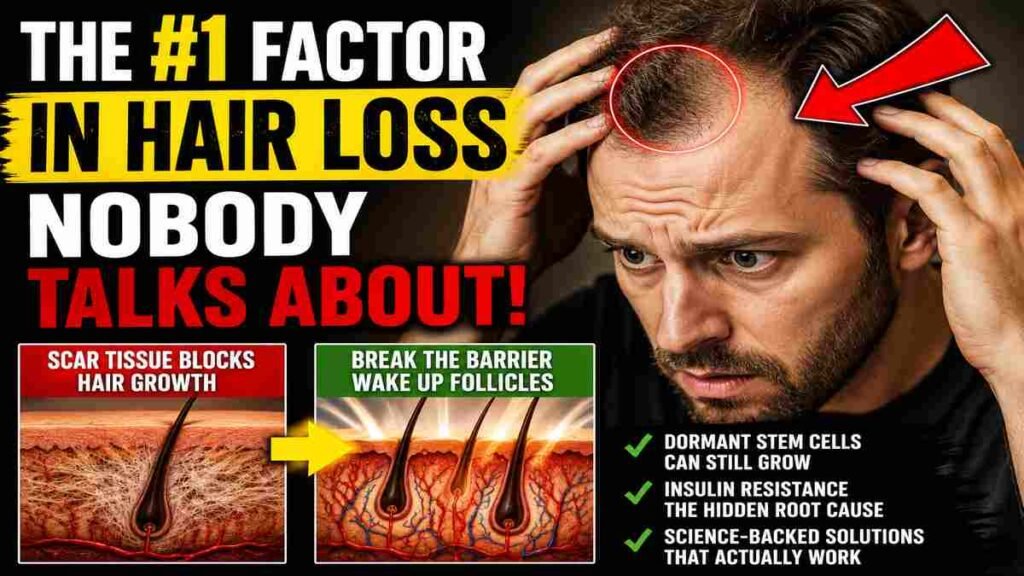
🧬 Your Hair Follicles May Still Be Alive
For years, many people believed baldness permanently destroyed hair follicles.
However, newer research paints a very different picture.
In 2024, researchers from the University of Virginia discovered that stem cells responsible for hair growth still exist even in completely bald scalp tissue.
That means many follicles are technically alive — just inactive.
Think of it like seeds buried in winter soil. The seeds still exist.
They simply cannot grow because the environment around them prevents it.
That idea alone explains why so many hair loss treatments fail.
The issue may not be the product but may be the environment surrounding the follicle.
🚨 The Hidden Hair Loss Problem: Scar Tissue
One of the most overlooked contributors to pattern hair loss is scar tissue formation underneath the scalp.
Over time, chronic inflammation can damage tiny blood vessels feeding the hair follicles.
As inflammation continues:
- blood flow decreases
- oxygen delivery drops
- nutrients struggle to reach the follicle
- calcification may develop
- collagen buildup hardens the scalp tissue
Eventually, this creates a physical barrier around the follicle.
As a result, the follicle enters a dormant state.
Several scalp biopsy studies on people with pattern hair loss found signs of fibrosis or scar tissue in a large percentage of cases.
That changes everything.
Because if scar tissue blocks circulation and healing, then even excellent remedies may struggle to work properly.
💡 Why Many Hair Loss Treatments Fail
This explains a frustrating reality many people experience.
Someone buys:
- rosemary oil
- expensive serums
- DHT blockers
- hair vitamins
and after months, nothing changes.
Naturally, they assume the treatment failed.
But according to this theory, the treatment may never have properly reached the follicle in the first place.
The barrier prevented it.
Imagine watering a plant while thick concrete covers the soil.
The water exists.
The nutrients exist.
But they cannot penetrate deeply enough to help the roots.
That is exactly how scalp scar tissue may behave.
🧪 The Bigger Problem May Not Be DHT
Most conversations about hair loss revolve around DHT.
DHT, or dihydrotestosterone, forms when testosterone converts into a more potent hormone.
Yes, DHT absolutely plays a role in pattern hair loss.
However, many experts now believe another deeper issue may drive the process even more aggressively:
Insulin resistance.
And this is where things get extremely interesting.
🍞 What Insulin Resistance Has to Do With Hair Loss
Insulin resistance occurs when the body produces high amounts of insulin, but the cells stop responding properly.
As a result:
- blood sugar regulation worsens
- inflammation increases
- circulation suffers
- hormone balance shifts
Now here’s the critical part:
Hair follicles rely heavily on glucose for energy.
However, if insulin resistance prevents glucose from entering cells efficiently, the follicle struggles to function optimally.
Additionally, insulin resistance contributes to:
- constricted blood vessels
- reduced circulation
- inflammation
- fibrosis formation
In other words, insulin resistance may indirectly create the perfect environment for hair loss.
📖 The 2024 Case Study That Shocked Researchers
A particularly fascinating 2024 case study highlighted this connection.
Researchers examined a man with classic male pattern baldness.
Surprisingly:
- his fasting glucose appeared normal
- but his fasting insulin was extremely high
That indicated severe insulin resistance beneath the surface.
He also displayed a dark velvety patch on the neck — a classic sign associated with insulin resistance and prediabetes.
Doctors then treated only the insulin resistance.
No:
- topical solutions
- hair drugs
- hair transplant
- scalp treatment
Just insulin management.
Within six months, significant hair regrowth reportedly occurred.
Now, that does not mean insulin resistance causes every case of hair loss.
However, it strongly suggests metabolic health may play a much bigger role than most people realize.
🥑 Why Low-Carb Diets May Help Hair Growth
If insulin resistance contributes to hair loss, then improving insulin sensitivity becomes extremely important.
That is why many experts recommend:
- low-carb eating
- ketogenic diets
- intermittent fasting
Reducing processed carbohydrates lowers insulin spikes.
Consequently:
- inflammation decreases
- circulation improves
- metabolic stress drops
Furthermore, intermittent fasting activates something called autophagy.
Autophagy acts like a cellular recycling system.
The body begins clearing:
- damaged proteins
- dysfunctional tissue
- cellular waste
Some researchers believe autophagy may also help reactivate dormant stem cells involved in hair growth.
⚠️ Why Completely Blocking DHT May Backfire
Many people assume DHT is purely harmful.
But that is not entirely true.
DHT also supports:
- libido
- confidence
- facial hair growth
- puberty development
- mood stability
In fact, some people using aggressive DHT-blocking medications experience:
- depression
- anxiety
- mood changes
- sexual dysfunction
Therefore, the goal should not always be eliminating DHT entirely.
Instead, the smarter approach may involve correcting the deeper metabolic problems driving imbalance in the first place.
🩸 Microneedling May Be the Missing Link
Now let’s talk about one of the most promising tools for breaking down scalp scar tissue:
Microneedling.
Microneedling involves creating tiny controlled punctures in the scalp using small needles.
That sounds intense, but the science behind it makes sense.
Those tiny micro-injuries stimulate a healing response.
During that repair process:
- blood flow increases
- collagen remodeling occurs
- scar tissue may break down
- healing factors activate
Most importantly, microneedling may temporarily “open the door” allowing topical treatments to penetrate deeper into the scalp.
Many researchers consider this one of the most effective non-surgical methods for improving topical absorption and scalp remodeling.
📌 How Microneedling Typically Gets Used
Most protocols recommend:
- needle depth between 1 mm and 1.5 mm
- sessions every 2–4 weeks
- avoiding harsh topicals immediately afterward
Usually, people wait 24–48 hours before applying treatments to avoid irritation.
And timing matters.
Because after microneedling, the scalp becomes more receptive for a short window.
That creates an opportunity for topical therapies to work more effectively.
🌙 Why Topical Melatonin Is Getting Attention
Most people associate melatonin with sleep.
However, researchers also discovered melatonin acts as a powerful antioxidant inside tissues.
Interestingly, topical melatonin may help stimulate hair growth pathways within the scalp.
Some studies suggest melatonin:
- reduces oxidative stress
- supports follicle activity
- protects scalp tissue
- improves hair density
Many people apply it at night because melatonin can also promote relaxation and sleepiness.
Combined with microneedling, topical melatonin may become significantly more effective because the scalp barrier temporarily opens.
🌿 Other Natural Remedies With Research Support
Several additional remedies also show promising evidence.
Rosemary Oil
🪴 Rosemary oil gained enormous popularity because some studies found results comparable to minoxidil over several months — but with fewer side effects.
Additionally, rosemary may:
- improve circulation
- reduce inflammation
- support scalp health
Saw Palmetto
🌱 Saw palmetto may help regulate DHT activity naturally.
Several clinical studies reported improvements in hair density and reduced shedding.
Pumpkin Seed Oil
🎃 Pumpkin seed oil also produced impressive findings in some randomized trials.
Certain participants experienced noticeable increases in hair density after consistent supplementation.
Onion Juice
🧅 Onion juice sounds strange, yet one famous study showed dramatic regrowth results in people with autoimmune-related hair loss.
Researchers believe quercetin — a powerful anti-inflammatory compound found in onions — likely contributed to those results.
However, onion juice appears more effective for autoimmune hair conditions than classic pattern baldness.
😰 Stress Might Accelerate Hair Loss More Than You Think
Stress plays a much bigger role in hair loss than many people realize.
When stress rises:
- cortisol increases
- inflammation worsens
- insulin resistance increases
- blood circulation suffers
That creates the perfect environment for shedding.
Interestingly, stress-related hair loss often appears months after the stressful event itself.
Therefore, many people never connect the two.
Long-term stress management becomes incredibly important for scalp health.
🚶 Simple Lifestyle Changes That May Help
Sometimes the most effective solutions look surprisingly basic.
Healthy habits that may support hair growth include:
- daily walking
- better sleep
- blood sugar control
- low-carb nutrition
- stress reduction
- consistent scalp care
Even vitamin B1 sometimes gets mentioned for supporting nervous system health and stress adaptation.
While no single remedy guarantees regrowth, improving the overall environment around the follicle dramatically increases the chances of success.
🧭 The Biggest Hair Loss Mistake People Make
The biggest mistake people make is focusing only on the hair itself.
Hair loss rarely exists in isolation.
Instead, it often reflects deeper problems involving:
- inflammation
- metabolism
- circulation
- stress
- hormonal imbalance
- scalp health
You cannot always fix the problem by attacking DHT alone.
Sometimes the real issue sits underneath the surface — literally.
And if scar tissue and insulin resistance truly play a major role, then treating only the symptom may never fully solve the root cause.
✅ Final Thoughts
Hair loss is far more complicated than most advertisements make it seem.
For decades, the conversation focused almost entirely on genetics and DHT. However, newer research now points toward something much deeper:
- chronic inflammation
- insulin resistance
- poor circulation
- scalp fibrosis
- dormant stem cells
That does not mean every bald person can regrow a full head of hair.
But it does suggest many follicles may still be alive — waiting for the right environment to wake back up.
And perhaps that is the most hopeful discovery of all.
❓FAQs About Hair Loss and Scar Tissue
Can scar tissue really cause hair loss?
Yes. Chronic inflammation may create fibrosis and reduced circulation around follicles, potentially contributing to dormant hair growth.
Are bald hair follicles actually dead?
Not always. Some newer research suggests dormant stem cells may still exist even in bald scalp tissue.
Does insulin resistance affect hair growth?
Possibly. Insulin resistance can worsen inflammation, circulation, and hormonal balance, all of which may influence hair health.
Is DHT the only cause of male pattern baldness?
No. DHT plays a role, but inflammation, metabolic health, genetics, and circulation also matter significantly.
Does microneedling help hair regrowth?
Many studies suggest microneedling may improve circulation, remodel scar tissue, and increase absorption of topical treatments.
Can rosemary oil regrow hair?
Some research suggests rosemary oil may improve hair density and perform similarly to minoxidil in certain cases.
Is stress-related hair loss reversible?
In many cases, yes. Reducing stress and improving recovery may help normalize shedding over time.
What diet may help improve hair health?
Low-carb diets and intermittent fasting may improve insulin sensitivity and reduce inflammation, which could indirectly support healthier hair growth.
Reviewer Bio:
Dr Prerna Sharma is a highly skilled and compassionate Hair Transplant Surgeon with 4 years of hands-on experience performing hair restoration procedures. Proficient in Follicular Unit Extraction (FUE) and Follicular Unit Transplantation (FUT), with a strong commitment to delivering natural-looking results and ensuring patient satisfaction. Demonstrated expertise in patient consultation, preoperative planning, and post-operative care. Adept at utilizing advanced hair restoration technologies and techniques to achieve optimal outcome .
Authoritative Source Links
- National Institutes of Health (NIH) – Hair Loss Research
- American Academy of Dermatology – Hair Loss Causes & Treatments
- Harvard Health – Understanding Hair Loss
- Mayo Clinic – Hair Loss Overview
- NIH – Microneedling and Hair Regrowth Studies
- Cleveland Clinic – Insulin Resistance Explained
- PubMed – Rosemary Oil vs Minoxidil Study
You may also like to read other health related articles here also authored by me :
Inculcate the Habit of Investing in Your Kids: Calculator Included
Why You Should Overcome Fear: The First Step Toward Success