- 🧠 Your Brain Runs on Limited Emotional Energy
- 🔋 Cognitive Load Quietly Exhausts You
- 🛡️ Why We Wear Emotional Armor Around Strangers
- 🏠 Home Feels Like a Safe Zone
- 🌍 Why Strangers Trigger More Politeness
- 📈 Dopamine Rewards Novelty
- 💔 Familiarity Sometimes Reduces Effort
- 🧩 Emotional Safety Creates Vulnerability
- 🚨 Why Guilt Appears Afterward
- 🧠 Why Emotional Regulation Weakens at Home
- ⚡ Why We Must Redirect Energy Back Home
- 🚗 The Five-Minute Reset Technique
- ❤️ Treat Family Like Strangers Sometimes
- 🌱 Small Acts of Kindness Matter More at Home
- 🏡 Your Family Sees the Unfiltered Version of You
- 🌌 The Bigger Truth About Human Relationships
- 🌟 How to Become Kinder at Home
- 🌟 Final Thoughts
- ❓ FAQs
You smile politely at a barista who gets your order completely wrong. So nice to strangers…
However, 20 minutes later, you snap at your partner because they misplaced your coffee mug.
Strange, isn’t it?
Most people have experienced this contradiction:
- Extra patience for strangers
- Short tempers with family
- Kindness for outsiders
- Frustration at home
Consequently, many people feel guilty afterward.
They wonder:
- “Am I taking my family for granted?”
- “Why am I kinder to random people?”
- “Why do the people I love get the worst version of me?”
⚡ Surprisingly, this behavior does not automatically mean you are selfish, fake, or emotionally cold.
Instead, your brain operates according to energy conservation, emotional safety, social survival, and neurological reward systems.
And once you understand the psychology behind it, everything starts making sense.
More importantly, you can finally begin fixing it.
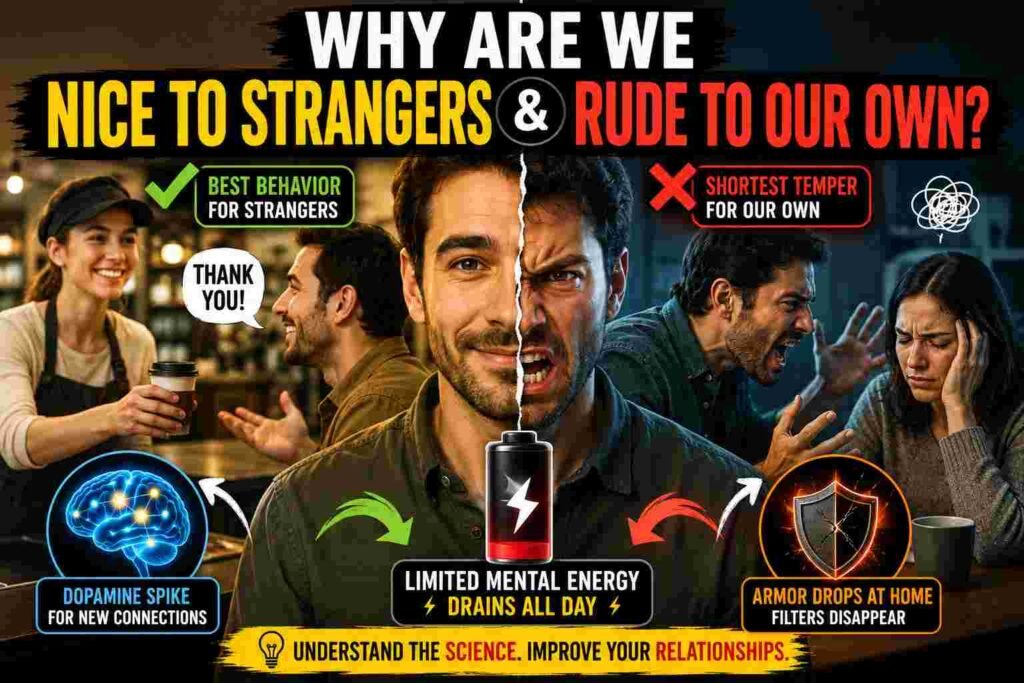
🧠 Your Brain Runs on Limited Emotional Energy
Imagine your brain like a smartphone battery.
Every morning, you wake up with a full emotional charge.
At first:
- You feel patient
- You think clearly
- You regulate emotions well
- You tolerate inconvenience calmly
However, throughout the day, your mental battery slowly drains.
Why?
Because social interaction consumes enormous psychological energy.
Every single interaction requires your brain to:
- Filter rude thoughts
- Follow social rules
- Maintain politeness
- Read body language
- Avoid conflict
- Control facial expressions
- Manage impressions
⚡ These processes sound automatic, but they are incredibly energy-intensive.
Psychologists often refer to this as cognitive load.
The heavier the cognitive load becomes, the harder emotional regulation gets later.
Consequently, by evening, your emotional battery may already be nearly empty.
And unfortunately, family members usually experience what remains.
🔋 Cognitive Load Quietly Exhausts You
Most people underestimate how exhausting modern social life really is.
Think about a normal day:
- Traffic frustration
- Work pressure
- Emails
- Notifications
- Meetings
- Small talk
- Customer service interactions
- Social media
- Decision fatigue
Individually, these moments seem harmless.
However, collectively, they drain massive mental energy.
📱 It works exactly like background apps draining your phone battery all day.
Even when you think you are “fine,” your nervous system may already be overloaded.
Therefore, when something minor happens at home:
- A misplaced remote
- Loud noise
- Dirty dishes
- Repeated questions
Your exhausted brain reacts emotionally much faster.
Not because you stopped loving your family.
Because your self-control resources already got spent elsewhere.
🛡️ Why We Wear Emotional Armor Around Strangers
Here’s another fascinating psychological layer.
Most people spend their public lives wearing invisible emotional armor.
This armor protects us socially.
It helps us:
- Avoid judgment
- Prevent embarrassment
- Stay socially accepted
- Reduce conflict
- Maintain reputation
Therefore, around strangers, we monitor ourselves constantly.
We become:
- More careful
- More diplomatic
- More filtered
- More polite
⚡ Your brain sees strangers as unpredictable territory.
And unpredictability requires caution.
Consequently, your nervous system stays highly regulated in public.
🏠 Home Feels Like a Safe Zone
Now here’s the important part.
The moment you walk through your front door, your brain recognizes safety.
Suddenly:
- The armor drops
- The monitoring relaxes
- Emotional filters weaken
- Tension releases
And honestly, this feels relieving initially.
However, there’s a downside.
⚠️ The same armor that protected you socially also helped regulate your reactions.
Without it:
- Irritation surfaces faster
- Patience shrinks
- Emotional restraint weakens
Ironically, we often behave worse with family because our brains trust they will not abandon us.
That trust creates emotional looseness.
You unconsciously think:
“These people will still love me even if I’m exhausted.”
And usually, they do.
However, repeated emotional carelessness slowly damages relationships over time.
🌍 Why Strangers Trigger More Politeness
At first glance, this behavior seems irrational.
Why impress people you may never see again?
The answer lies deep inside human evolution.
🧠 The brain rewards social novelty.
For ancient humans, new allies increased survival chances dramatically.
A stranger could become:
- Protection
- Food access
- Trade opportunities
- Community support
Therefore, evolution rewarded successful interactions with unfamiliar people.
Even today, your brain releases dopamine during socially successful new interactions.
This creates:
- Excitement
- Curiosity
- Engagement
- Increased politeness
⚡ In simple words:
Your brain treats strangers as “potential opportunity.”
Meanwhile, familiar people feel predictable and emotionally secure.
📈 Dopamine Rewards Novelty
This is why:
- New friendships feel exciting
- New relationships feel electric
- First conversations feel stimulating
Novelty activates dopamine strongly.
However, long-term relationships create something different:
- Stability
- Comfort
- Predictability
- Emotional grounding
These qualities feel safe, but they do not produce the same intense neurological spike.
Consequently, your brain naturally invests more immediate social energy into unfamiliar people.
Not because strangers matter more.
Because novelty temporarily activates stronger reward pathways.
💔 Familiarity Sometimes Reduces Effort
Sadly, familiarity can accidentally reduce intentional kindness.
People stop saying:
- “Thank you”
- “I appreciate you”
- “How was your day?”
- “I’m sorry”
Why?
Because the relationship feels permanent.
⚠️ This becomes dangerous.
Relationships rarely collapse from one dramatic moment.
Instead, emotional neglect slowly accumulates through:
- Small irritations
- Short tempers
- Lack of appreciation
- Emotional exhaustion
Meanwhile, strangers continue receiving polished behavior.
Eventually, loved ones begin feeling emotionally underfed.
🧩 Emotional Safety Creates Vulnerability
Here’s something important most people misunderstand.
Being emotionally raw at home is not entirely negative.
In fact, emotional safety allows authenticity.
That vulnerability matters deeply.
However, there is a critical difference between:
- Safe emotional honesty
and - Repeated emotional dumping
⚡ One strengthens connection.
The other slowly damages it.
Therefore, awareness becomes essential.
🚨 Why Guilt Appears Afterward
Most emotionally healthy people feel guilt after snapping at loved ones.
That guilt exists because:
- Your values conflict with your behavior
- You know your family deserves better
- You recognize the unfairness emotionally
And honestly, guilt itself is not the enemy.
Healthy guilt signals awareness.
The real problem begins when people normalize emotional neglect completely.
🧠 Why Emotional Regulation Weakens at Home
Your prefrontal cortex handles:
- Self-control
- Emotional regulation
- Impulse management
- Rational decision-making
However, this system tires throughout the day.
Psychologists often call this phenomenon ego depletion.
The more decisions, stress, and emotional regulation you perform externally, the weaker self-control becomes later.
Therefore:
- Minor annoyances feel bigger
- Emotional reactions intensify
- Patience decreases sharply
This explains why nighttime arguments often escalate more easily than morning conversations.
⚡ Why We Must Redirect Energy Back Home
Since biology naturally prioritizes novelty and social survival, we must intentionally protect close relationships.
Healthy relationships require conscious effort.
Not accidental leftovers.
Therefore, people must deliberately redirect emotional energy toward home life.
Because without intention, exhaustion automatically takes over.
🚗 The Five-Minute Reset Technique
One powerful solution involves creating transition rituals.
For example:
- Sit quietly in your car for 5 minutes
- Take deep breaths before entering home
- Listen to calming music
- Mentally separate work stress from family interaction
🧘 This brief reset helps recharge emotional awareness before interacting with loved ones.
Consequently, your nervous system enters home more intentionally rather than reactively.
❤️ Treat Family Like Strangers Sometimes
This sounds strange initially, yet it works beautifully.
Ask yourself:
“Would I speak to a stranger this way?”
Usually, the answer becomes obvious instantly.
You would probably never:
- Roll your eyes aggressively
- Use harsh tones
- Ignore them dismissively
- Snap impulsively
Therefore, intentionally bringing public-level politeness into private relationships changes everything.
Not fake politeness.
Conscious respect.
🌱 Small Acts of Kindness Matter More at Home
People often chase grand romantic gestures while ignoring tiny daily behaviors.
However, relationships survive through small consistent moments.
For example:
- Listening fully
- Saying thank you
- Offering patience
- Speaking gently
- Acknowledging effort
- Showing appreciation
These tiny actions create emotional safety over time.
⚡ Consistency matters far more than occasional intensity.
🏡 Your Family Sees the Unfiltered Version of You
Strangers see:
- Your presentation
- Your social mask
- Your controlled behavior
Family sees:
- Your exhaustion
- Your stress
- Your fears
- Your emotional reality
That level of exposure creates intimacy.
However, intimacy also demands responsibility.
Because the people closest to you often absorb emotional overflow from the outside world.
🌌 The Bigger Truth About Human Relationships
Humans are emotionally complicated creatures.
We crave:
- Novelty
- Safety
- Freedom
- Stability
- Excitement
- Familiarity
Sometimes these needs conflict internally.
Consequently, the brain behaves in ways that feel contradictory.
Yet understanding the psychology behind these patterns changes everything.
Instead of thinking:
“I’m a terrible person.”
You begin realizing:
“My brain is exhausted, overloaded, and running automatic survival patterns.”
That awareness creates room for intentional change.
🌟 How to Become Kinder at Home
Improvement does not require perfection.
Instead, focus on awareness and small corrections.
✅ Pause Before Reacting
Exhaustion amplifies emotional reactions.
Therefore, pause briefly before responding emotionally.
✅ Protect Your Mental Energy
Reduce unnecessary stressors where possible.
Mental overload directly affects relationship quality.
✅ Communicate Fatigue Honestly
Instead of snapping, say:
“I’m mentally exhausted right now.”
That honesty prevents unnecessary conflict.
✅ Appreciate Familiar People Deliberately
Never let familiarity erase gratitude.
People who stay beside you deserve intentional kindness.
✅ Create Recovery Rituals
Build transitions between public stress and home life.
Your nervous system needs decompression.
🌟 Final Thoughts
The reason we act nicer to strangers than our own family does not usually come from lack of love.
Instead, it comes from:
- Cognitive exhaustion
- Emotional safety
- Evolutionary wiring
- Dopamine responses
- Nervous system fatigue
Understanding this removes unnecessary shame.
However, it also creates responsibility.
Because while your biology explains the behavior, it should not permanently excuse it.
⚡ The people who receive your leftovers emotionally are often the people who love you the most.
And honestly, they deserve more than emotional scraps after the world drains you all day.
Therefore:
- Protect your energy
- Reset intentionally
- Speak more gently
- Appreciate familiarity
- Bring conscious kindness back home
Because strangers may remember your politeness briefly.
But your family remembers your emotional patterns forever.
❓ FAQs
❓ Why are people often kinder to strangers than family?
People usually regulate emotions more carefully around strangers because unfamiliar social interactions require caution, impression management, and self-monitoring.
❓ What is cognitive load?
Cognitive load refers to the mental effort your brain uses to process information, decisions, emotions, and social interactions throughout the day.
❓ Why do people lose patience at home?
Home feels emotionally safe. Consequently, the brain relaxes its social filters and emotional monitoring, especially after exhausting public interactions.
❓ Does this behavior mean someone loves strangers more?
No. Usually, it reflects emotional exhaustion, nervous system fatigue, and unconscious psychological patterns rather than lack of love.
❓ What role does dopamine play in this behavior?
Novel social interactions trigger stronger dopamine responses because the brain naturally rewards social novelty and new connections.
❓ How can I stop snapping at loved ones?
You can:
- Take transition breaks
- Protect mental energy
- Pause before reacting
- Communicate exhaustion honestly
- Practice intentional kindness daily
❓ Can emotional exhaustion damage relationships?
Yes. Repeated emotional dumping, irritability, and lack of appreciation can slowly weaken emotional connection over time.
This article has been made with the help of AI for better SEO but the research and inputs have been provided by me. Sources cited below.
- American Psychological Association – Stress and Cognitive Load
- Harvard Health – Understanding Emotional Regulation and Mental Fatigue
- Psychology Today – Why We Hurt the People We Love
- Cleveland Clinic – Emotional Exhaustion and Burnout Explained
- Verywell Mind – Cognitive Load and Emotional Stress
- Stanford Encyclopedia of Philosophy – Emotion and Human Behavior
You may also like to read other health related articles here also authored by me :
Simi Valley Fire: How to Protect Yourself in Such Situations
Amy Schumer Opens Up About ‘Botched’ Medical Procedure
Silent Signs of Dementia: Early Symptoms Many Families Overlook
Warm Lemon Water: First Thing You Should Take After Waking Up?
HRSA Community Health Centre: #cheapermedicare
Tecentriq SC Injection: The New 7-Minute Cancer Shot for Patients