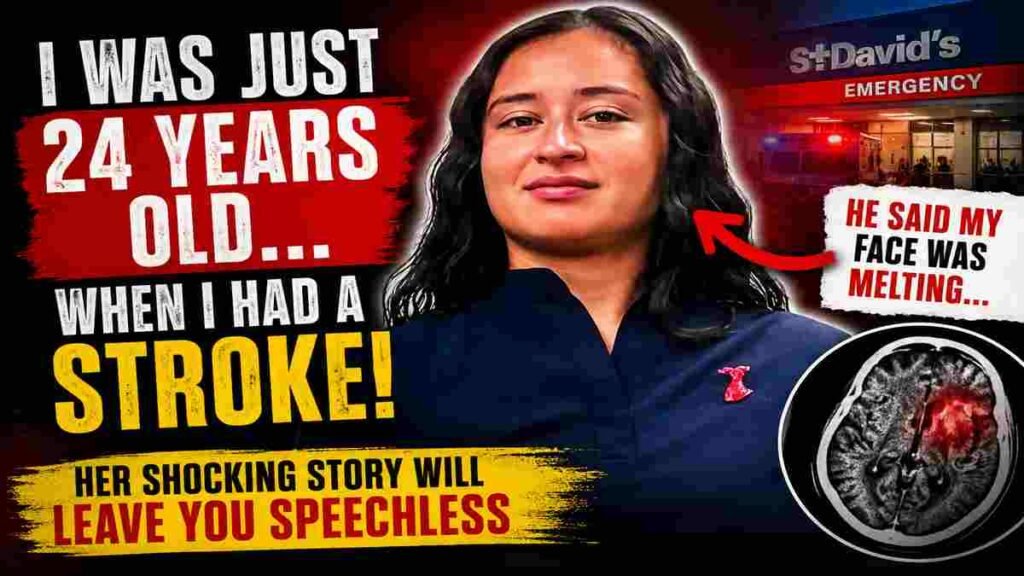
When most people think about strokes, they imagine elderly patients with long histories of medical problems. But for , a healthy 24-year-old emergency room nurse from Round Rock, a stroke became a terrifying reality that nearly changed her life forever.
“I Thought I Was Too Young to Have a Stroke”
In 2023, Alex Wilson Garza suddenly began feeling dizzy and disoriented while at home. What started as mild discomfort quickly escalated into a medical emergency.
“I just remember the world becoming super dizzy,” Alex recalled. “Then after that, I don’t really remember much.”
Her Husband Immediately Knew Something Was Wrong
Her husband, Caleb — a police officer — noticed something was seriously wrong almost immediately. Alex’s speech became slurred, she struggled to walk, and she lost control of the left side of her body. At one point, she attempted to pick something up and accidentally flung it across the room. The left side of her face also began drooping.
“He described it like my face was melting,” Alex said.
Recognizing the symptoms of a possible stroke, Caleb rushed her to St. David’s Round Rock Medical Center — the same hospital where Alex worked as an ER nurse.
Ironically, even with her medical background, Alex initially struggled to believe she could actually be having a stroke.
“There was definitely denial,” she admitted. “I was young and healthy. I thought there couldn’t really be something wrong.”
But hospital staff acted quickly.
Nurse manager described the moment she realized her own colleague had arrived with stroke symptoms.
“You hear ‘24-year-old female having stroke symptoms’ and you immediately think, ‘That can’t be real,’” she explained.
Doctors Raced Against Time to Save Her Brain
Doctors immediately performed a CT scan to determine the type of stroke Alex was experiencing. Because she arrived at the hospital within the critical treatment window, physicians were able to administer a clot-busting medication called TPA, which helps dissolve blood clots blocking blood flow to the brain.
Alex also underwent a thrombectomy, a specialized procedure where doctors inserted a device through an artery to physically remove the clot from her brain.
The fast response likely saved her life.
According to stroke experts, every minute matters during a stroke because brain cells begin dying rapidly when blood flow is interrupted. Medical professionals often use the phrase “Time is brain” to emphasize the urgency.
Could Birth Control Increase Stroke Risk in Young Women?
After spending several days in the ICU for monitoring, Alex made a remarkable recovery with few long-term complications. However, emotionally, the experience left a lasting impact.
“I was terrified of it happening again,” she said. “It was hard being alone for a while because I kept thinking it could come back.”
Doctors later suggested that oral birth control may have contributed to the blood clot that caused the stroke, since some hormonal contraceptives can increase clotting risks in certain patients. Alex has since stopped taking that medication and now focuses heavily on maintaining a healthy lifestyle and monitoring her health closely.
Today, Alex works alongside organizations like the American Heart Association and the American Stroke Association to raise awareness about stroke symptoms — especially among young women.
She hopes her story reminds others that strokes can happen even to people who appear healthy.
“I may not fit the description of a typical stroke patient because I’m young,” Alex said. “But it can still happen to us.”
Understanding the “BE FAST” Stroke Warning Signs
Medical experts encourage people to remember the acronym “BE FAST” when identifying stroke symptoms:
- B — Balance: Sudden loss of balance or coordination
- E — Eyes: Vision problems or sudden loss of sight
- F — Face: Facial drooping on one side
- A — Arms: Weakness or numbness in one arm
- S — Speech: Slurred or difficult speech
- T — Time: Call emergency services immediately
How the Experience Changed Her Life as a Nurse
Alex now says the experience transformed not only her life, but also the way she treats patients in the emergency room.
“Every patient coming through our doors is probably having one of the worst days of their life,” she explained. “After my stroke, I understand that on a much deeper level.”
AUTHORITATIVE SOURCE LINKS:
• American Stroke Association – Stroke Warning Signs and Symptoms
• American Heart Association
• CDC – Stroke Facts and Prevention
• National Institute of Neurological Disorders and Stroke
• Mayo Clinic – Stroke Symptoms and Causes
• Cleveland Clinic – Signs of Stroke in Women
Also Read:
Unbearable Wait Time in Canadian Hospitals: Province wise Workarounds
Deductible vs Out-of-Pocket Maximum: How Much Will You Actually Pay Hospital?