- 💸 What Is Surprise Billing?
- ⚖️ What Is the No Surprises Act?
- I added the Act below for your convenience, but to go to a particular page you must type the page number to the left of /133 on top of the document 😊😊💕
- See the downloadable document above: The 5 Pages I’d Personally Keep Ready
- What You Can Say to a Hospital Billing Department
- Most Important Concept for Patients
- 🏥 When the No Surprises Act Protects You?
- 📋 What Is Balance Billing?
- 🔍 How the No Surprises Act Works
- 🧾 What Patients Still Need to Watch For
- 💡 How to Protect Yourself From Surprise Billing
- 🚨 What to Do If You Receive a Surprise Medical Bill
- 🌎 Why the No Surprises Act Matters
- 📈 How Healthcare Providers Responded
- 🧭 Final Thoughts
- ❓FAQs About Surprise Billing and the No Surprises Act
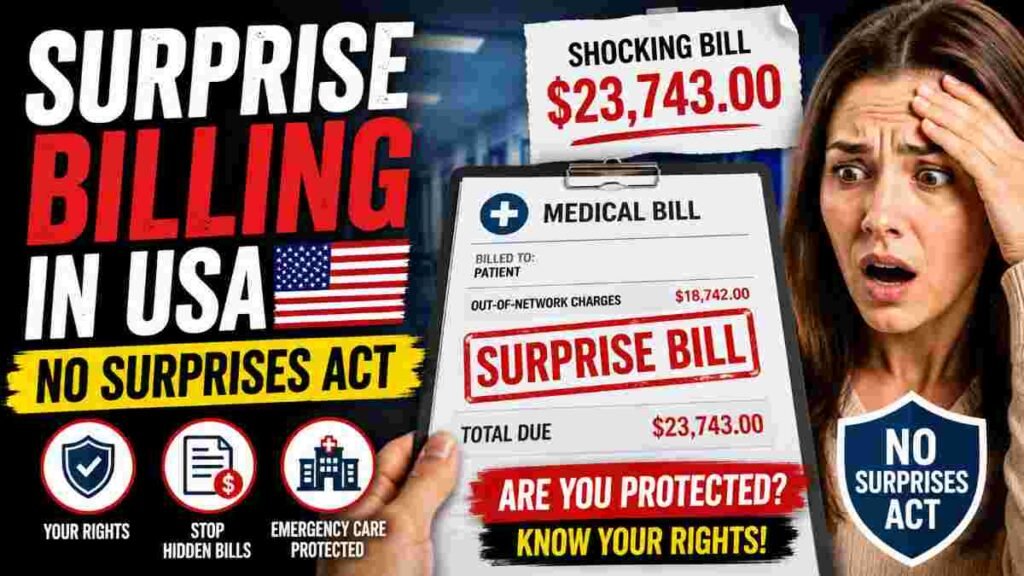
Getting a huge medical bill after an emergency treatment feels frustrating, confusing, and honestly unfair. Thankfully, the No Surprises Act now protects millions of Americans from unexpected medical charges called surprise billing.
In simple terms, the law prevents patients from receiving massive out-of-network bills during emergencies or certain hospital visits when they had little or no choice in selecting providers. Instead of paying outrageous costs, patients usually pay only their normal in-network amount.
However, while the law offers strong protection, many people still do not fully understand how it works. Therefore, this guide breaks everything down in plain English — including your rights, what surprise billing means, how the No Surprises Act helps, and what you should do if you still receive an unfair medical bill.
💸 What Is Surprise Billing?
Surprise billing happens when you receive an unexpected medical bill from an out-of-network healthcare provider, even though you thought your treatment was covered by insurance.
For example:
- You visit an in-network hospital
- However, the anesthesiologist is out-of-network
- Later, you receive a massive separate bill
As a result, patients often face thousands of dollars in unexpected costs.
Before the law changed, many Americans discovered these bills only after treatment. Consequently, medical debt became a huge national problem.
⚖️ What Is the No Surprises Act?
The No Surprises Act is a federal law that took effect in January 2022 in the United States. It protects patients from many unexpected medical bills involving out-of-network care.
Essentially, the law limits how much providers can charge patients in specific situations.
Under the law:
- Patients usually pay only in-network cost-sharing amounts
- Providers cannot send surprise balance bills in many emergency cases
- Hospitals must give clearer pricing information
- Patients gain stronger billing protections
Therefore, the law gives consumers more financial predictability during stressful medical situations.
I added the Act below for your convenience, but to go to a particular page you must type the page number to the left of /133 on top of the document 😊😊💕
See the downloadable document above: The 5 Pages I’d Personally Keep Ready
If you want the shortest practical reference set:
| Situation | PDF Pages |
|---|---|
| Emergency surprise bills | 15–18 |
| Out-of-network doctor at in-network hospital | 11–13 |
| Consent requirements | 18–19 |
| In-network cost-sharing protection | 16–17 |
| Non-emergency hospital protections | 24–25 |
What You Can Say to a Hospital Billing Department
You can use simple wording like:
“Under the No Surprises Act, I should not receive out-of-network balance billing for emergency services or for nonparticipating providers at an in-network facility unless proper notice and consent requirements were met.”
Then reference:
- PDF pages 15–18 for emergency protections
- PDF pages 11–13 and 24–25 for in-network hospital protections
Most Important Concept for Patients
The strongest patient-friendly idea in the law is:
If you did not knowingly choose an out-of-network provider, you usually should not receive surprise balance bills.
That principle appears repeatedly throughout the Act.
“Hey there, Sam the author here. If you have enjoyed my blog so far or it is of any value to you, would you consider sharing this blog or website with your friends or families? We being a new website have got lots of resistence we need to overcome. Some Love from you would definitely propel us further.
Also dont forget to comment any other topic you want me to cover. Warm Regards”
🏥 When the No Surprises Act Protects You?
The law covers several common healthcare situations.
🚑 Emergency Services
If you receive emergency care at any hospital, your insurance must generally treat it like in-network care.
That means:
- No massive out-of-network balance bills
- No higher emergency charges simply because providers were outside your network
Importantly, these protections apply even if:
- You cannot choose the provider
- The ambulance or ER doctor is out-of-network
- You receive emergency stabilization services
🩺 In-Network Hospitals With Out-of-Network Providers
This situation caused many surprise bills before the law.
For instance, you may choose an in-network hospital but unknowingly receive treatment from:
- An anesthesiologist
- A radiologist
- A pathologist
- An assistant surgeon
Previously, those specialists could bill patients separately at extremely high rates.
Now, the No Surprises Act usually prevents those surprise charges.
✈️ Air Ambulance Services
Air ambulance bills often reached tens of thousands of dollars.
Thankfully, the law now protects patients from many unexpected air ambulance charges as well.
However, ground ambulance services remain a major gap in federal protection in many states.
📋 What Is Balance Billing?
Balance billing occurs when an out-of-network provider bills you for the difference between:
- What your insurance paid
- The provider’s full charge
For example:
- Provider charges $4,000
- Insurance pays $1,500
- Provider bills you for the remaining $2,500
Before the No Surprises Act, this practice created financial disasters for many families.
Now, in protected situations, providers cannot legally send those extra bills.
🔍 How the No Surprises Act Works
The law creates a negotiation process between insurers and providers instead of forcing patients to pay the difference.
Here’s how it works:
- Patient receives treatment
- Insurance pays its portion
- Provider and insurer negotiate remaining costs
- Independent dispute resolution may occur if disagreements continue
Meanwhile, the patient pays only the normal in-network amount.
Consequently, consumers avoid becoming stuck in the middle of billing disputes.
🧾 What Patients Still Need to Watch For
Although the law helps tremendously, patients should still remain careful.
⚠️ Not Every Bill Is Illegal
Some out-of-network charges remain legal.
For example:
- Non-emergency care at out-of-network facilities
- Ground ambulance services in many states
- Services you knowingly agreed to receive
Therefore, reading paperwork carefully still matters.
🖊️ Consent Forms Matter
Sometimes providers ask patients to sign consent forms agreeing to out-of-network treatment costs.
However, strict rules apply:
- Providers must give advance notice
- Consent must be voluntary
- Emergency situations usually cannot use these waivers
If providers pressure you into signing quickly, ask questions immediately.
💡 How to Protect Yourself From Surprise Billing
Even with legal protections, smart preparation still helps.
📞 Verify Network Status Before Treatment
Whenever possible:
- Ask whether doctors are in-network
- Confirm hospital participation
- Contact your insurance provider directly
Additionally, ask specifically about:
- Anesthesiologists
- Radiologists
- Lab services
These specialists commonly create surprise bills.
📄 Request Cost Estimates
Under federal rules, uninsured or self-pay patients can often request good faith estimates before treatment.
As a result, you gain a better understanding of expected healthcare costs.
🧠 Keep Detailed Records
Save:
- Bills
- Insurance explanations of benefits (EOBs)
- Emails
- Consent forms
- Payment receipts
If disputes arise later, documentation helps tremendously.
🚨 What to Do If You Receive a Surprise Medical Bill
Receiving a shocking medical bill feels stressful. Nevertheless, do not panic.
Instead, follow these steps carefully.
📋 Review the Bill Thoroughly
Check:
- Dates of service
- Provider names
- Billing codes
- Insurance processing details
Sometimes simple errors create huge billing problems.
📞 Contact Your Insurance Company
Ask:
- Was the claim processed correctly?
- Does the No Surprises Act apply?
- Was the provider improperly categorized?
Insurance representatives can often clarify confusing charges quickly.
🏥 Call the Provider’s Billing Department
Explain politely but firmly:
“I believe this bill may violate the No Surprises Act.”
Many providers correct mistakes after review.
⚖️ File a Complaint If Necessary
If problems continue, you can file complaints through federal agencies.
The Centers for Medicare & Medicaid Services (CMS) manages many consumer complaint processes related to surprise billing protections.
🌎 Why the No Surprises Act Matters
Medical emergencies already create emotional stress. Unexpected bills only make situations worse.
Before the law:
- Families drained savings
- Patients delayed treatment
- Medical debt increased rapidly
Now, consumers have stronger financial protections and more transparency.
Although the healthcare system still faces challenges, the No Surprises Act represents one of the biggest patient-protection reforms in recent years.
📈 How Healthcare Providers Responded
Many hospitals and insurers support parts of the law. However, disputes continue over payment calculations between providers and insurance companies.
Some provider groups argue:
- Insurers gain too much negotiating power
- Reimbursement rates remain too low
Meanwhile, consumer advocates believe the law still needs stronger enforcement.
Therefore, healthcare billing reform continues evolving across the United States.
🧭 Final Thoughts
Surprise medical bills once trapped countless Americans in financial confusion. Thankfully, the No Surprises Act now offers major protections against many unexpected healthcare charges.
Still, patients should stay proactive.
Ask questions, review bills carefully, verify insurance coverage, and understand your rights before treatment whenever possible.
Most importantly, remember this:
You do not have to accept every unexpected medical bill without questioning it.
Knowledge truly becomes your best financial defense in today’s healthcare system.
❓FAQs About Surprise Billing and the No Surprises Act
What is surprise billing?
Surprise billing occurs when patients receive unexpected out-of-network medical charges after treatment.
What does the No Surprises Act do?
The law protects patients from many unexpected balance bills involving emergency services and certain out-of-network providers at in-network facilities.
Does the No Surprises Act cover emergency rooms?
Yes. Emergency services generally receive protection under the law, even if providers are out-of-network.
Are air ambulances covered?
Yes. The law includes protections for many air ambulance services.
Does the law cover ground ambulances?
Not always. Federal protections for ground ambulance services remain limited in many states.
Can providers still send balance bills?
In some situations, yes. However, providers cannot legally balance bill patients in many protected emergency and hospital scenarios.
What should I do if I receive a surprise medical bill?
Review the bill carefully, contact your insurance company, speak with the provider’s billing office, and file a complaint if necessary.
When did the No Surprises Act start?
The law officially took effect on January 1, 2022.
Authoritative Source Links
U.S. Department of Health & Human Services – No Surprises Help Desk
Centers for Medicare & Medicaid Services – No Surprises Act
Healthcare.gov – Protections Against Surprise Billing
American Medical Association – Surprise Billing Overview
KFF Health News – Surprise Medical Bills Coverage
Consumer Financial Protection Bureau – Medical Debt Resources
You may also like to read other health related articles here also authored by me :
Simi Valley Fire: How to Protect Yourself in Such Situations
Amy Schumer Opens Up About ‘Botched’ Medical Procedure
Silent Signs of Dementia: Early Symptoms Many Families Overlook
Warm Lemon Water: First Thing You Should Take After Waking Up?
HRSA Community Health Centre: #cheapermedicare
Tecentriq SC Injection: The New 7-Minute Cancer Shot for Patients