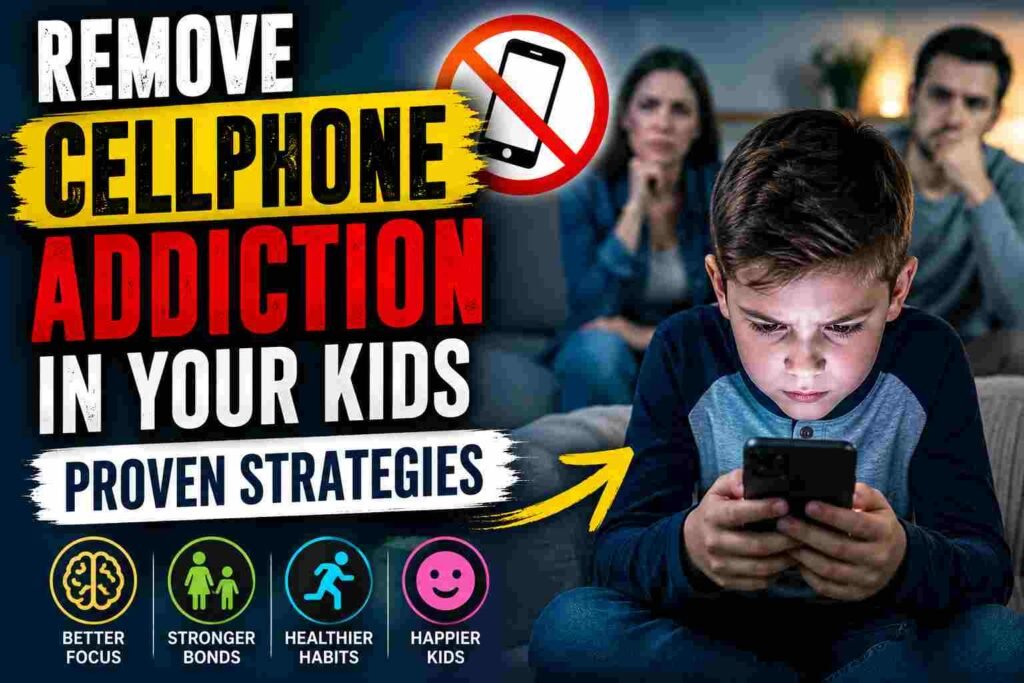
- 📱 Why Cellphone Addiction in Kids Is Growing Rapidly
- 🚨 Warning Signs of Cellphone Addiction in Kids
- 🧠 Understand the Root Cause Before You React
- 🎯 Proven Strategies to Remove Cellphone Addiction in Kids
- 📚 The Psychological Impact of Excessive Smartphone Use
- ⚡ Why Punishment Alone Usually Fails
- 🧠 Build Digital Discipline, Not Digital Fear
- 👨👩👧 Family Habits Matter More Than Lectures
- 🌟 Final Thoughts
- ❓ FAQs
Modern parenting comes with challenges no previous generation faced. Today, children carry an entire world inside their pockets. Entertainment, games, videos, social media, and endless notifications compete for their attention every single second.
At first, smartphones seem harmless. Parents often hand over a device to calm a child during meals, long drives, or busy moments. However, over time, occasional screen use can slowly become dependency.
⚠️ Suddenly, your child feels restless without a phone. Conversations become shorter. Outdoor play disappears. Sleep quality drops. Mood swings increase. School performance suffers.
Many parents now ask the same difficult question:
How do I remove cellphone addiction in my kids without constant fights and emotional breakdowns?
The good news is this:
You do not need extreme punishments or aggressive restrictions. Instead, you need smart, balanced, and consistent strategies. This guide explores scientifically supported and practical ways to reduce phone dependency while improving your child’s emotional health, focus, discipline, and happiness.
📱 Why Cellphone Addiction in Kids Is Growing Rapidly
Children today grow up in a completely different environment than previous generations.
Unlike earlier decades, smartphones now provide:
- Instant entertainment
- Endless scrolling
- Dopamine-driven rewards
- Social validation
- Gaming stimulation
- Constant distraction
As a result, children’s brains become highly responsive to digital stimulation.
🧠 Every notification, video, or game reward triggers dopamine release inside the brain. Consequently, kids begin craving more screen time repeatedly.
Over time, many children struggle to enjoy slower real-world activities such as:
- Reading
- Outdoor play
- Studying
- Family conversations
- Creative hobbies
Unfortunately, excessive smartphone use can also affect:
- Attention span
- Emotional regulation
- Sleep quality
- Academic performance
- Physical activity
- Social development
Therefore, parents must take action early before unhealthy habits become deeply rooted.
🚨 Warning Signs of Cellphone Addiction in Kids
Many parents notice the problem only after it becomes severe.
Therefore, recognizing early warning signs matters enormously.
Here are common symptoms of unhealthy phone dependency:
📵 Emotional Outbursts Without the Phone
If your child becomes angry, anxious, or aggressive when you remove the device, dependency may already exist.
🌙 Poor Sleep Habits
Late-night scrolling, gaming, or video watching can disrupt sleep cycles significantly.
Consequently, children wake up tired, irritated, and mentally exhausted.
📚 Declining Academic Focus
Children addicted to phones often struggle with:
- Concentration
- Homework completion
- Memory retention
- Classroom engagement
🧍 Reduced Social Interaction
Kids may avoid:
- Family gatherings
- Outdoor activities
- Real-life friendships
Instead, they retreat into digital worlds.
⚡ Constant Phone Checking
Even short periods without the device feel uncomfortable for addicted children.
They repeatedly check:
- Notifications
- Messages
- Games
- Social media apps
😔 Mood Swings and Irritability
Excessive screen exposure often affects emotional stability.
As a result, children become impatient, frustrated, or emotionally reactive.
Recognizing these signs early makes intervention far easier.
🧠 Understand the Root Cause Before You React
One major parenting mistake involves treating the phone as the only problem.
Actually, the phone often becomes an escape.
Children may use smartphones to avoid:
- Boredom
- Loneliness
- Stress
- Anxiety
- Social pressure
- Academic pressure
Therefore, before implementing rules, understand what emotional need the phone fulfills.
👨👩👧 Sometimes children simply lack engaging alternatives.
Other times, they imitate adult behavior because parents also spend excessive time on screens.
Consequently, solving cellphone addiction requires emotional awareness — not just restrictions.
🎯 Proven Strategies to Remove Cellphone Addiction in Kids
Now let’s explore practical and highly effective solutions that genuinely work.
📅 1. Create Structured Screen-Time Rules
Children need consistency.
Without clear boundaries, screen time expands endlessly.
Therefore, establish predictable phone rules such as:
- No phones during meals
- No screens before bedtime
- Homework before entertainment
- Limited daily screen hours
⚡ Importantly, explain the reason behind the rules calmly instead of sounding authoritarian.
Children cooperate more when they understand the purpose.
For example:
- “Phones affect sleep.”
- “Too much screen time hurts focus.”
- “Your brain also needs rest.”
Consistency matters more than strictness.
🛏️ 2. Remove Phones From Bedrooms at Night
This single strategy produces massive improvements.
Nighttime phone usage destroys healthy sleep patterns.
Moreover, children often secretly:
- Watch videos
- Play games
- Scroll social media
- Chat with friends
As a result, their brains remain overstimulated long after bedtime.
📴 Therefore, create a family charging station outside bedrooms.
This rule should apply to everyone — including parents.
When children see fairness, resistance decreases significantly.
🌳 3. Replace Screen Time With Exciting Alternatives
One reason restrictions fail is simple:
Parents remove screens without adding enjoyable alternatives.
Consequently, children feel punished and bored.
Instead, introduce engaging activities such as:
- Sports
- Cycling
- Drawing
- Martial arts
- Music lessons
- Reading challenges
- Gardening
- Cooking together
⚽ Physical activities work especially well because movement naturally boosts mood and dopamine levels.
Eventually, children rediscover enjoyment beyond screens.
👨👩👧 4. Become a Role Model Yourself
Children copy behavior far more than instructions.
If parents constantly scroll through phones, children will naturally imitate them.
Therefore, examine your own habits honestly.
📱 Ask yourself:
- Do I check my phone during conversations?
- Do I use screens during meals?
- Do I spend excessive time online?
Healthy parenting starts with visible example-setting.
Consequently, try implementing:
- Family no-phone hours
- Device-free dinners
- Weekend outdoor routines
When parents participate actively, children resist less.
🧩 5. Teach Self-Control Instead of Pure Obedience
Many parents rely only on commands:
- “Stop using the phone.”
- “Give me your device.”
- “Enough screen time.”
However, long-term success requires internal discipline.
Therefore, teach children:
- Why balance matters
- How addiction develops
- How technology affects the brain
🧠 Explain dopamine in simple terms:
“Apps are designed to keep you scrolling longer.”
Children become more cooperative when they understand manipulation tactics used by apps and platforms.
Education creates awareness.
Awareness builds self-control.
⏰ 6. Use Gradual Reduction Instead of Sudden Elimination
Sudden restrictions often trigger emotional battles.
Therefore, reduce usage gradually.
For example:
- Reduce screen time by 20 minutes weekly
- Remove one unnecessary app first
- Introduce tech-free periods slowly
This approach feels less threatening to children.
Consequently, resistance decreases dramatically.
Small improvements sustained consistently create lasting change.
❤️ 7. Strengthen Emotional Connection With Your Child
Many children turn toward screens because emotional connection weakens at home.
Therefore, intentional bonding becomes extremely important.
Spend quality time:
- Talking
- Walking
- Playing games
- Cooking together
- Listening without judgment
👂 Sometimes children simply want attention, validation, and emotional safety.
When emotional connection improves, dependency on digital stimulation often decreases naturally.
📖 8. Encourage Real-World Achievement
Phones provide instant gratification.
Real-life growth takes effort.
Therefore, help children build confidence through meaningful achievements.
Encourage:
- Sports competitions
- Art projects
- Reading goals
- Skill-building activities
- Public speaking
- Team activities
🏆 Achievement in the real world creates genuine self-esteem.
Consequently, children rely less on digital validation.
🧘 9. Teach Boredom Tolerance
Modern children rarely experience boredom because screens constantly entertain them.
However, boredom actually develops:
- Creativity
- Problem-solving
- Imagination
- Patience
Therefore, avoid instantly handing over devices whenever children feel bored.
Instead, encourage them to:
- Create something
- Explore hobbies
- Think independently
Initially, they may resist. However, eventually, their brains adapt.
🔒 10. Use Parental Controls Wisely
Technology itself is not evil.
Therefore, use digital tools intelligently.
Parental control apps can help:
- Limit screen time
- Block harmful content
- Monitor app usage
- Schedule downtime
However, avoid excessive spying or controlling behavior.
⚖️ Balance protection with trust.
Children need guidance — not constant surveillance.
📚 The Psychological Impact of Excessive Smartphone Use
Understanding consequences helps parents stay motivated.
Excessive phone use can contribute to:
😴 Sleep Problems
Blue light exposure disrupts melatonin production and sleep quality.
📉 Reduced Attention Span
Fast-paced content weakens sustained focus abilities.
😟 Increased Anxiety
Social media comparison often damages self-esteem.
🧠 Lower Academic Performance
Distraction reduces learning efficiency and memory retention.
🚶 Reduced Physical Health
Children move less when screens dominate daily life.
Consequently, obesity risk and posture problems may increase.
⚡ Why Punishment Alone Usually Fails
Many frustrated parents eventually confiscate phones aggressively.
Although temporary restriction may help briefly, punishment alone rarely solves the deeper issue.
Why?
Because children often return to excessive usage immediately afterward.
Instead of fear-based parenting, focus on:
- Communication
- Structure
- Emotional connection
- Consistency
- Healthy alternatives
Lasting behavioral change requires cooperation, not constant conflict.
🧠 Build Digital Discipline, Not Digital Fear
Technology will remain part of modern life.
Therefore, the goal should not be complete elimination.
Instead, teach balanced and responsible usage.
Children must learn:
- When to disconnect
- How to control impulses
- How to prioritize responsibilities
- How to protect mental health
⚡ Digital discipline becomes one of the most valuable life skills in the modern world.
👨👩👧 Family Habits Matter More Than Lectures
Children remember family culture more than speeches.
Therefore, create healthy household habits:
- Outdoor weekends
- Shared meals
- Reading time
- Exercise routines
- Device-free conversations
These small rituals gradually reshape behavior naturally.
Consistency always beats intensity.
🌟 Final Thoughts
Removing cellphone addiction in children does not happen overnight. However, with patience, consistency, and emotional connection, parents can completely change the direction of their child’s habits.
The most important thing to remember is this:
📱 Children are not addicted to screens because they are lazy or disobedient.
Instead, phones often become:
- An escape from boredom
- A source of comfort
- A replacement for connection
- A quick source of dopamine and entertainment
Therefore, punishment alone rarely solves the problem.
Instead, real progress happens when parents create:
- Better routines
- Stronger relationships
- Healthier alternatives
- Clear boundaries
- Positive role models
The good news is that kids respond surprisingly fast when families consistently apply the right strategies.
At first, your child may resist screen limits. They may complain, negotiate, or even become angry. Nevertheless, stay calm and stay consistent. Over time, their brain slowly adjusts to healthier stimulation.
🧠 Eventually, you will notice:
- Better focus
- Improved sleep
- Stronger communication
- More outdoor activity
- Better emotional balance
- Increased creativity
Most importantly, you will begin rebuilding genuine family connection.
Remember, children learn more from what parents do than what parents say.
So, if you want to remove cellphone addiction in your kids, begin by creating a healthier digital environment for the entire household.
Small daily changes create massive long-term results.
And ultimately, the goal is not to completely remove technology from your child’s life.
Instead, the goal is balance.
Because when children learn how to control technology — instead of letting technology control them — they become healthier, happier, and mentally stronger for life.
❓ FAQs
❓ What causes cellphone addiction in kids?
Several factors contribute to cellphone addiction in children, including:
- Social media
- Video games
- Short-form videos
- Lack of outdoor activity
- Peer pressure
- Boredom
- Emotional stress
Additionally, apps are specifically designed to keep users engaged for long periods through dopamine-triggering notifications and endless scrolling.
❓ How many hours of screen time are healthy for kids?
Healthy screen time depends on age. However, most experts recommend:
- Limited screen exposure for toddlers
- 1–2 hours of recreational screen time for school-age children
- Balanced use with physical activity, sleep, and family interaction for teenagers
The quality of content matters just as much as the quantity.
❓ Can cellphone addiction affect my child’s brain?
Yes. Excessive screen exposure may affect:
- Attention span
- Emotional regulation
- Sleep quality
- Memory
- Social development
Furthermore, constant dopamine stimulation can make offline activities feel less enjoyable over time.
❓ What are the warning signs of cellphone addiction in kids?
⚠️ Common warning signs include:
- Anger when the phone is taken away
- Loss of interest in hobbies
- Poor sleep
- Reduced physical activity
- Constant checking of notifications
- Declining academic performance
- Isolation from family
If several of these signs appear consistently, your child may have an unhealthy dependence on screens.
❓ Should parents completely ban smartphones?
Usually, no.
A complete ban often creates rebellion and secrecy. Instead, parents should focus on:
- Healthy boundaries
- Time limits
- Device-free routines
- Open communication
- Balanced activities
Teaching responsible usage works better than extreme restriction in most situations.
❓ How can I reduce my child’s screen time without arguments?
👨👩👧 The best approach is gradual change.
Try:
- Creating fun offline activities
- Setting predictable routines
- Using parental controls calmly
- Offering choices instead of commands
- Spending more quality time together
Children cooperate more when they feel understood rather than controlled.
❓ Does outdoor activity help reduce cellphone addiction?
Absolutely.
Outdoor play naturally reduces screen dependence because it provides:
- Physical stimulation
- Social interaction
- Mental refreshment
- Real-world excitement
Consequently, children who spend more time outdoors often show healthier digital habits.
❓ What is the best age to give a child a smartphone?
There is no perfect universal age. Instead, parents should evaluate:
- Emotional maturity
- Responsibility
- Self-control
- Online safety awareness
Many experts recommend delaying smartphones as long as reasonably possible while teaching healthy digital habits early.
❓ Can parents accidentally increase cellphone addiction?
Yes.
Children copy adult behavior constantly. Therefore, when parents spend excessive time on phones, kids often imitate those habits.
That is why family-wide digital balance creates the strongest results.
❓ How long does it take to reduce cellphone addiction in kids?
Every child is different. However, noticeable improvement often appears within a few weeks when parents consistently apply:
- Screen limits
- Better routines
- Offline engagement
- Emotional connection
- Positive reinforcement
Consistency matters far more than perfection.
This article has been made with the help of AI for better SEO but the research and inputs have been provided by me. Sources cited below.
- American Academy of Pediatrics – Screen Time Guidelines for Children
- Mayo Clinic – Children and Screen Time Tips
- World Health Organization – Guidelines on Physical Activity and Sedentary Behaviour for Children
- Harvard Medical School – How Screen Time Affects Kids’ Brains
- Cleveland Clinic – Signs of Screen Addiction in Children
- Common Sense Media – Family Screen Time Advice
You may also like to read other health related articles here also authored by me :
Gym Herpes Outbreak? How to Stay Safe While Working Out
Can Apple Cider Vinegar Help Weight Loss Journey?
Mewing Explained: Does This Viral Jawline Trend Actually Work?
What Your Hands Are Warning You About Your Heart: Hidden Signs