- 🎯 Why the Special Forces Mindset Matters
- 🧠 Your Brain Cannot Ignore Negative Self-Talk
- 🔥 The Two Faces of Self-Criticism
- ⚔️ The Special Forces Mindset Under Pressure
- 🛡️ Special Forces Mindset Rule #1: Talk Like a Coach
- 🧠 Special Forces Mindset Rule #2: Separate Identity From Behavior
- 🚀 Special Forces Mindset Rule #3: Balance Criticism With Action
- Start — Stop — Continue
- 🧭 Why Ownership Builds Confidence
- ⚡ The Hidden Cost of Constant Self-Attack
- 🏋️ The Special Forces Mindset Is Trainable
- 🔥 Practical Daily Exercises to Build the Special Forces Mindset
- 🧩 Performance Improves When Internal Dialogue Improves
- 🎯 Final Thoughts
- FAQs
Let’s dive into the world of Special Forces Mindset today. The world of David Goggins. Every person has an internal voice running in the background. Sometimes it motivates you. However, other times, it quietly destroys your confidence, focus, and performance. That voice becomes even louder when pressure rises.
A missed deadline.
A failed business pitch.
A poor exam result.
A mistake during training.
Instead of correcting the problem, many people immediately attack themselves.
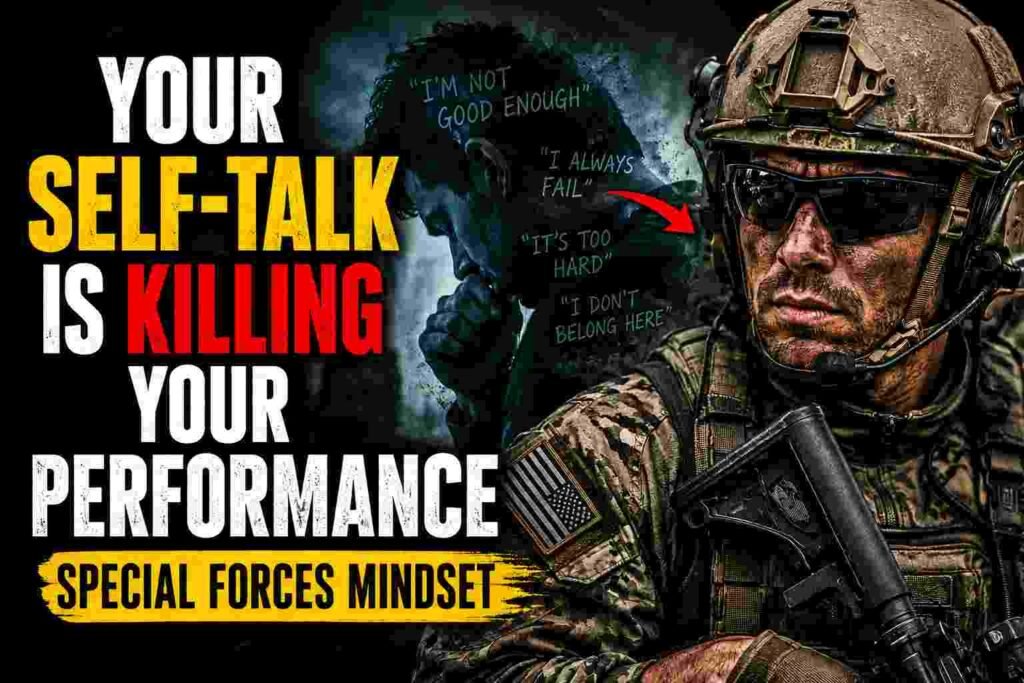
“You always fail.”
“You’re not good enough.”
“You don’t belong here.”
⚠️ The dangerous part is this: your brain treats those words like a real threat.
As a result, your body responds with stress, anxiety, hesitation, and mental paralysis. Consequently, performance drops further. Then the inner critic becomes even harsher. Over time, this cycle slowly destroys confidence from the inside out.
Yet elite performers operate differently.
Whether in the military, sports, business, or leadership, high performers understand one critical truth:
Your internal dialogue can either sharpen your performance or sabotage it.
The difference lies in how you use self-criticism.
This is the essence of the Special Forces Mindset.
🎯 Why the Special Forces Mindset Matters
In special forces training, mistakes carry serious consequences. Sometimes, a single error can risk an entire mission. Therefore, operators must constantly evaluate their actions under pressure.
However, here’s what makes elite performers different:
They do not destroy themselves after mistakes.
Instead, they analyze the issue, adapt quickly, and move forward with clarity.
That distinction changes everything.
Amateurs often turn mistakes into identity attacks:
- “I’m useless.”
- “I’m weak.”
- “I always mess things up.”
Professionals focus on behavior instead:
- “I missed the detail.”
- “My timing was off.”
- “I need a better process next time.”
🧠 This subtle shift protects confidence while still encouraging improvement.
Consequently, elite performers stay calm under pressure while others spiral emotionally.
🧠 Your Brain Cannot Ignore Negative Self-Talk
Many people think harsh self-criticism creates discipline. Unfortunately, science says otherwise.
Research shows that self-criticism activates areas of the brain linked to:
- Stress responses
- Negative emotions
- Fear detection
- Anxiety regulation
In moderation, constructive feedback helps growth. However, relentless internal attacks create a completely different effect.
Your nervous system reacts as though you are under physical danger.
As a result:
- Focus decreases
- Decision-making worsens
- Confidence collapses
- Motivation fades
- Performance declines
Eventually, the mind starts expecting failure before challenges even begin.
This creates what psychologists call learned helplessness.
⚡ In simple terms, you stop believing improvement is possible.
That is why destructive self-talk quietly kills performance in business, sports, relationships, leadership, and life.
🔥 The Two Faces of Self-Criticism
Not all self-criticism is bad.
In fact, elite performers rely on it constantly.
However, there are two completely different forms of self-evaluation.
1. Constructive Self-Criticism
This approach focuses on behavior and improvement.
Examples include:
- “I lost focus during the presentation.”
- “I rushed that decision.”
- “My preparation wasn’t strong enough.”
Constructive feedback creates action.
Therefore, the brain starts solving problems instead of defending identity.
Athletes review game footage this way.
Military teams conduct after-action reviews this way.
Successful CEOs analyze failed projects this way.
Importantly, the goal is improvement — not humiliation.
2. Destructive Self-Criticism
This approach attacks identity instead of behavior.
Examples include:
- “I’m terrible at this.”
- “I always fail.”
- “I’m not smart enough.”
⚠️ This language feels personal and permanent.
Consequently, the brain interprets failure as proof of inadequacy rather than an opportunity to improve.
Over time, confidence erodes completely.
This is where many talented people collapse mentally.
⚔️ The Special Forces Mindset Under Pressure
Special forces selection pushes people into extreme stress with very little external feedback.
Candidates often receive:
- No encouragement
- No reassurance
- No emotional support
- No constant coaching
Instead, instructors observe silently.
Why?
Because they want to see how candidates manage themselves internally.
Can they self-correct without spiraling emotionally?
or can they stay composed after mistakes?
Can they maintain confidence under pressure?
💡 Most failures happen mentally before they happen physically.
One navigation error becomes:
“I don’t belong here.”
One missed timing standard becomes:
“Everyone else is stronger than me.”
Soon afterward, performance deteriorates further because the internal dialogue becomes destructive.
Eventually, many candidates quit — not because their bodies fail, but because their mindset collapses.
Meanwhile, successful candidates use a different process.
They acknowledge mistakes without emotionally destroying themselves.
That is the core of the Special Forces Mindset.
🛡️ Special Forces Mindset Rule #1: Talk Like a Coach
The first tactic is simple but incredibly powerful.
Whenever your internal voice becomes aggressive, ask yourself:
“Would I speak this way to someone I respect?”
Most people instantly realize the answer is no.
If a teammate struggled during a presentation, you would probably say:
- “You handled most of it well.”
- “Slow down during the difficult section next time.”
- “You can improve this with practice.”
You would not say:
- “You’re hopeless.”
- “You always embarrass yourself.”
Yet many people speak to themselves far worse than they would ever speak to a friend.
⚡ That destroys confidence unnecessarily.
The Special Forces Mindset teaches emotional control through professional communication — even internally.
Constructive coaching improves performance.
Personal attacks destroy it.
Therefore, shift your language immediately.
Instead of:
- “I’m terrible at public speaking.”
Say:
- “I need more repetition and pacing control.”
The second version creates growth.
The first version creates paralysis.
🧠 Special Forces Mindset Rule #2: Separate Identity From Behavior
This principle changes performance dramatically.
Elite performers never confuse mistakes with identity.
They criticize actions — not character.
That distinction matters because the brain processes them differently.
For example:
❌ “I’m a failure.”
✅ “That strategy failed.”
❌ “I’m weak.”
✅ “My preparation wasn’t strong enough.”
🧩 One statement creates hopelessness. The other creates solutions.
Psychologist Carol Dweck explains this through the concept of the growth mindset.
People who believe skills can improve consistently outperform those who believe abilities are fixed.
Therefore, one small word becomes incredibly powerful:
Yet.
- “I haven’t mastered this yet.”
- “I’m not consistent yet.”
- “I haven’t solved this yet.”
That word tells the brain improvement remains possible.
Consequently, motivation stays alive even during failure.
Elite marathon runner Eliud Kipchoge demonstrates this mindset beautifully.
After a disappointing Olympic performance, he did not emotionally collapse or attack himself personally.
Instead, he calmly analyzed the issue and focused on adjustments.
That is professional self-criticism.
That is the Special Forces Mindset.
🚀 Special Forces Mindset Rule #3: Balance Criticism With Action
Self-criticism without action becomes emotional noise.
Unfortunately, many people stop at the emotional reaction.
They say:
- “I’m not good enough.”
- “I messed everything up.”
- “I always fail.”
However, none of those statements create a solution.
Therefore, elite performers use a structured process:
Start — Stop — Continue
✅ Start
What should you begin doing?
❌ Stop
What behavior must change?
🔄 Continue
What already works well?
This framework immediately shifts the brain toward problem-solving.
For example:
Instead of:
- “I completely failed that meeting.”
Use:
- “I need to start preparing clearer opening points.”
- “I need to stop rushing answers.”
- “I should continue using strong data examples.”
⚡ Suddenly, the mind sees a pathway forward.
That reduces emotional overwhelm while improving future performance.
The Special Forces Mindset always connects criticism to corrective action.
Without action, criticism becomes self-destruction.
🧭 Why Ownership Builds Confidence
Interestingly, many people think confidence comes from perfection.
Actually, confidence comes from honest ownership.
In elite military teams, operators openly admit mistakes during debriefs.
Not because they are weak.
Because ownership accelerates improvement.
Nobody wastes energy protecting ego.
Instead, they focus entirely on learning.
That creates psychological safety, trust, and rapid growth.
Similarly, strong leaders in business admit mistakes quickly.
As a result:
- Teams trust them more
- Communication improves
- Innovation increases
- Fear decreases
Ironically, avoiding mistakes often creates bigger problems than admitting them honestly.
The Special Forces Mindset understands that ownership strengthens performance rather than weakening it.
⚡ The Hidden Cost of Constant Self-Attack
Many ambitious people secretly believe harsh self-criticism proves discipline.
However, relentless self-attack creates several hidden dangers.
🔻 Burnout
Constant mental pressure exhausts the nervous system.
🔻 Anxiety
The brain starts anticipating failure constantly.
🔻 Reduced Creativity
Fear blocks experimentation and innovation.
🔻 Paralysis
Overthinking replaces action.
🔻 Lower Resilience
People recover more slowly from setbacks.
Consequently, performance keeps deteriorating even though effort increases.
This explains why many talented individuals remain stuck despite working incredibly hard.
Their internal environment becomes hostile.
The brain performs poorly under constant threat.
🏋️ The Special Forces Mindset Is Trainable
The good news is this:
You can completely retrain your internal dialogue.
However, it requires repetition.
At first, you will notice destructive self-talk after it happens.
Then, with practice, you will catch it during the moment.
Eventually, you will interrupt the pattern before it fully begins.
That is mental conditioning.
🧠 Just like physical training strengthens muscles, deliberate mental repetition strengthens emotional control.
This is why elite performers practice mindset daily.
Not occasionally.
Not randomly.
Consistently.
Because performance under pressure always reflects training.
🔥 Practical Daily Exercises to Build the Special Forces Mindset
Here are several powerful habits you can begin immediately.
📓 1. Conduct Personal Debriefs
At the end of each day, ask:
- What went well?
- What failed?
- What can improve tomorrow?
Keep answers objective and behavior-focused.
🎯 2. Replace Emotional Language
Catch phrases like:
- “I’m useless.”
- “I always fail.”
Replace them with:
- “This approach didn’t work.”
- “I need more practice.”
This single adjustment changes brain response dramatically.
🧘 3. Pause Before Reacting
When mistakes happen, avoid emotional reactions for a few minutes.
Instead:
- Breathe
- Analyze
- Refocus
High performers respond deliberately rather than emotionally.
📈 4. Track Small Wins
The brain naturally remembers failures more intensely.
Therefore, consciously record improvements and progress.
This builds realistic confidence over time.
⚔️ 5. Train Under Pressure
Pressure reveals mental habits.
Therefore, challenge yourself regularly:
- Public speaking
- Competitive environments
- Difficult conversations
- New responsibilities
The more pressure you experience constructively, the stronger your mindset becomes.
🧩 Performance Improves When Internal Dialogue Improves
Your internal voice shapes:
- Confidence
- Resilience
- Decision-making
- Leadership
- Emotional control
Therefore, mastering self-talk is not “soft psychology.”
It is performance training.
The Special Forces Mindset teaches that mistakes should sharpen you — not destroy you.
Professionals learn, adapt, and move forward quickly.
Amateurs emotionally spiral.
That difference changes careers, businesses, relationships, and lives.
🎯 Final Thoughts
Your self-talk either becomes your greatest weapon or your greatest weakness.
Every mistake gives you two choices:
- Attack yourself emotionally
- Analyze yourself professionally
The first destroys performance.
The second builds it.
The Special Forces Mindset does not avoid self-criticism. Instead, it uses self-criticism strategically.
Remember these three rules:
- Talk like a coach
- Separate identity from behavior
- Balance criticism with action
⚡ When you master those habits, pressure stops breaking you and starts sharpening you.
Because elite performance is not built through self-hatred.
It is built through disciplined self-awareness.
And like every skill, it improves through repetition.
Train your mind daily.
FAQs
❓ What is the Special Forces Mindset?
The Special Forces Mindset refers to the mental approach elite operators use under pressure. It focuses on emotional control, accountability, adaptability, and constructive self-evaluation instead of destructive self-criticism.
❓ Why does negative self-talk hurt performance?
Negative self-talk activates stress responses in the brain. Consequently, focus, confidence, decision-making, and motivation decline. Over time, constant internal criticism can lead to anxiety, burnout, and learned helplessness.
❓ How can I stop destructive self-criticism?
You can reduce destructive self-talk by:
- Talking to yourself like a coach
- Separating identity from mistakes
- Using action-focused feedback
- Practicing emotional awareness daily
❓ Is self-criticism always harmful?
No. Constructive self-criticism helps improvement when it focuses on behavior and solutions. However, destructive self-criticism becomes harmful when it attacks personal identity instead of specific actions.
❓ How do elite performers handle mistakes?
Elite performers analyze mistakes objectively, identify lessons quickly, and take corrective action without emotionally spiraling. This allows them to recover faster and maintain confidence under pressure.
❓ Can mindset training improve confidence?
Absolutely. Repeated mental conditioning improves emotional resilience, confidence, stress management, and performance over time. Just like physical fitness, mindset becomes stronger through consistent training.
This article has been made with the help of AI for better SEO but the research and inputs have been provided by me. Sources cited below.
- Stanford University – Carol Dweck’s Growth Mindset Research
- American Psychological Association – Stress Effects on the Brain and Body
- Harvard Business Review – The Power of Self-Compassion at Work
- Mayo Clinic – Positive Thinking and Stress Management
- Cleveland Clinic – How Negative Self-Talk Affects Mental Health
- Verywell Mind – Constructive vs Destructive Self-Criticism
You may also like to read other health related articles here also authored by me :
Gym Herpes Outbreak? How to Stay Safe While Working Out
Can Apple Cider Vinegar Help Weight Loss Journey?
Mewing Explained: Does This Viral Jawline Trend Actually Work?
What Your Hands Are Warning You About Your Heart: Hidden Signs